



Home meal delivery: the main families of service
Home meal delivery means every arrangement that lets you eat a meal prepared by someone else without leaving your home: an order brought by a restaurant or an app, a regular round for older people, a dish cooked on the spot by a chef or caterer, or the specialities of a far-off country carried to your door. The label therefore hides very different realities, from a dinner ordered on a tired evening to a daily service that helps someone stay in their own home.
Three families emerge. The first is on-demand delivery, quick and spontaneous, built around convenience and pleasure. The second is the recurring service, with menus planned a week ahead, widespread among older people, those recovering from illness and family carers. The third is made-to-measure catering: a cook comes to prepare a dinner, a caterer delivers a buffet, a provider adapts its recipes to a diet. Each family has its own rules on price, timing, hygiene and responsibility.
Telling them apart avoids nasty surprises. A restaurant that delivers carries different obligations from a meal-round company, a private chef is not a caterer, and an app is not necessarily the business that cooks the food. These nuances matter as soon as you compare offers or entrust a meal to a frail person.
Takeaway and food delivery apps: restaurants, platforms and dark kitchens
On-demand delivery is the most visible form. The customer picks a dish from a restaurant, a rotisserie, a pizzeria or a kitchen built only for online sales, and a courier on a bike, scooter or in a car brings it within a few dozen minutes. Some businesses run their own deliveries, while others use an app that gathers hundreds of addresses.
The food that travels well is not what tastes best at the table. Slow-cooked dishes, curries, rice, well-packed pizzas, baked pasta and sushi survive the trip. Fine fried food, ready-dressed salads and frozen desserts suffer from the wait. A good business packs sauces separately, chooses suitable containers and shows the time of preparation.
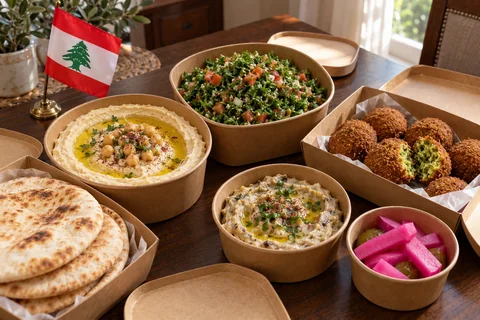
Delivered world cuisines have profited from this habit: you can discover a tagine, a bibimbap, a mafé or a chicken yassa without leaving the sofa. Prices, service fees and tips vary from country to country, so read the order breakdown before confirming.
Meals on wheels: a service for older and vulnerable people
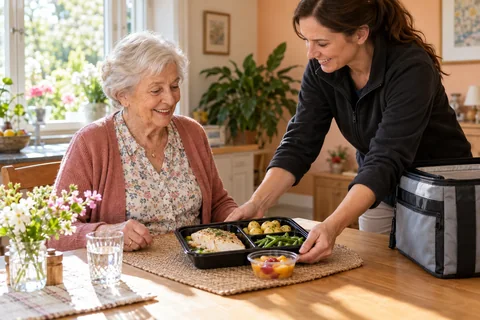
Meals on wheels means delivering to a person, several times a week or every day, balanced menus designed for their age or situation. The meals most often arrive in chilled trays to be warmed in an oven or microwave, sometimes hot in an insulated box. The person at the door is often the only visitor of the day, which gives the service a social dimension.
It is meant for older people, but also for disabled people, those convalescing after hospital and those worn out by illness. A relative can order from a distance for a parent. Menus can be adapted: puréed or minced texture, low salt, no added sugar, no pork.
In France, such a service often falls to a municipal social action centre, a département or a specialist private firm. In Belgium, public social action centres and the home-help services of health funds play that role; in Switzerland, home care and support organisations; in Quebec, the community service known as popote roulante. Depending on the situation, help can reduce the bill, but conditions differ from one territory to another.
Private chef at home or caterer: when the meal comes with a cook
A private chef at home travels to the customer with the ingredients, cooks in the customer’s kitchen, sometimes serves at the table, then tidies up. The result resembles a private gourmet dinner: a birthday, a business meal, an evening for two, a family cooking lesson. A caterer, on the other hand, cooks in a workshop and delivers platters, buffets or dishes to reheat, and may also serve on site.
The difference lies in equipment, responsibility and budget. Ask who brings the tableware, who shops, who cleans, how many guests are the maximum and what happens in case of cancellation. A written quote lists the dishes, quantities, travel and service time; be wary of vague packages.
For small gatherings as for receptions, the order of magnitude is worked out in advance: a seasonal menu, declared allergens, a guest list with each person’s food restrictions. A serious professional states their status, their insurance and their compliance with the hygiene rules that apply to the activity.
Special diets: halal, kosher, gluten-free and plant-based
Eating meals at home does not mean giving up your beliefs or your health. Halal meals follow Islamic requirements, notably on the origin of meat; kosher meals follow Jewish tradition, with rabbinical supervision and a strict separation of meat and dairy. In both cases, ask for the name of the certifying body and read the list of ingredients.
A gluten-free diet concerns coeliac people in particular, for whom cross-contamination is the real danger: the same fryer or the same chopping board is enough. Vegetarian and plant-based diets mean checking stocks, sauces and desserts. A serious provider answers frankly about its preparation methods.
The fourteen allergens subject to mandatory declaration in the European Union must appear on the label or be given when ordering. For any health question, a doctor or dietitian remains the person to ask: a meal provider never replaces personal advice.
Home-delivered meals around the world: UK, Ireland, Belgium, Switzerland, Canada, the US
Vocabulary and habits change from country to country. In the United Kingdom and Ireland the phrase "meals on wheels" is familiar, along with takeaway, councils and charities that serve older residents, and supermarket or app delivery for everyone else. In the United States, local meals-on-wheels programmes run by community organisations coexist with delivery apps in the big cities.
In Belgium, hot meals brought by family-help services and health funds have a long history. In Switzerland, the service varies strongly from canton to canton, and organisations for older people are common contacts. In Canada, especially Quebec, community groups and volunteers carry meals alongside the platforms that mostly cover large cities.
French-speaking Africa, the overseas territories and many other regions have their own traditions: street food, family canteens, grilled fish, curries and fritters. Fresh produce, heat and distance force care in transport and storage. Reading the local rules for each territory is the best way to avoid preconceptions.
Reheating, storage and safety: the right reflexes
A delivered meal is a perishable product. As soon as it arrives, it goes into the fridge if it will not be eaten at once, and the fridge should stay at around 4 °C or lower. Respect the use-by date on the tray and do not keep the leftovers of an opened dish longer than the provider advises.
Reheating must bring the dish piping hot all the way through: stir halfway in the microwave, cover it, then leave it to stand for a minute. Reheat only once. Dishes containing rice, eggs, poultry or seafood call for special care.
Older people, pregnant women and young children are more sensitive to food poisoning. A delivery left on the doorstep for hours without a cool box has no place in the cold chain; prefer a hand-to-hand handover or a precise time slot.
Choosing a meal provider: questions to ask and mistakes to avoid
Before choosing a home meal delivery service, ask simple questions. Who prepares the dishes and where? What are the ordering and cancellation deadlines? Can a dish be swapped, a week suspended, the service stopped without penalty? Are the detailed ingredients and allergens provided? Who answers if a delivery is late or damaged?
The frequent errors are well known: trusting a photo without reading the ingredients, ordering for a relative without asking their tastes, forgetting to check the delivery area, ignoring the room available in the fridge or accepting a long commitment with no trial period. A one-week trial soon shows whether portions, taste and punctuality suit.
On budget, compare the total price including delivery and check possible help with the local council, the pension fund or the health insurer. For example, the same meal can cost noticeably less once help is deducted, but these schemes depend on the place and the case.
Frequently asked questions
What is home meal delivery?
It covers every meal prepared by a third party and eaten at home: delivery by a restaurant or app, meals on wheels for older people, a caterer’s dishes or a dinner cooked on site by a private chef. Each option has its own rules on price, timing and hygiene.
What is the difference between food delivery and meals on wheels?
Food delivery answers a one-off order, often within a few dozen minutes. Meals on wheels is a regular service with planned menus designed for older or frail people, and a driver who calls on the same days.
Can I get help paying for home-delivered meals?
Sometimes. Depending on the country, help may come from a council, a pension fund, a health insurer or a tax benefit for personal services. Conditions depend on the place and on the person, so ask the organisations concerned.
How do I keep a delivered meal safe?
Put it in the fridge on arrival, respect the use-by date, reheat it piping hot once only and throw away anything left for a long time at room temperature.