
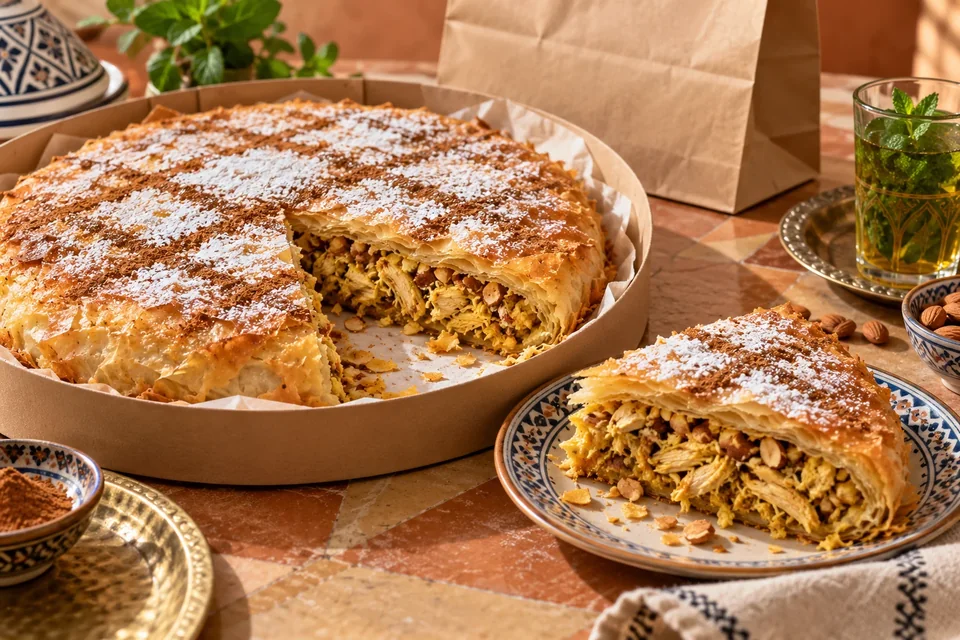
Pastilla delivery: what arrives at your door
Pastilla delivery is the service by which a caterer or restaurant prepares a Moroccan layered pie and brings it to your home, ready to go into the oven. The name is also spelt bastilla or b’stilla. Its paper-thin sheets of pastry, called warqa, wrap a filling in which sweet and savoury answer each other, and the top is dusted with icing sugar and cinnamon.
The recipe is linked with the city of Fès and the Andalusian side of Moroccan cooking. The classic version uses pigeon, but chicken is now by far the most common, particularly in families and with caterers serving the diaspora. It appears at weddings, religious festivals and family reunions, and as a showpiece when guests are invited.
Ordering pastilla suits anyone who loves the dish but does not have the hours, or the stack of warqa, to make it at home.
Chicken, pigeon, seafood and milk: the main variations
Pastilla is not one single recipe. Depending on the region and the cook, several versions can be ordered:
- chicken pastilla, the most common, with toasted almonds, eggs cooked into the sauce and mild spices;
- pigeon pastilla, the traditional version, rarer and sometimes available only on advance order;
- seafood or fish pastilla, savoury and often without sugar, seen on tables along the coast;
- milk pastilla, a dessert of crisp sheets and cream scented with orange blossom;
- individual formats, small triangles or cigars, served as a nibble with drinks or a starter.
If a menu simply says pastilla, ask which filling it contains and whether the sugar and cinnamon are on top. Preferences differ widely between households.
Ordering pastilla: what goes in it and how big to buy
A chicken pastilla usually includes shredded poultry, softened onions, parsley and coriander, ginger, saffron, ras el hanout or other spices depending on the house, eggs and chopped almonds. Everything is wrapped in buttered or oiled sheets of warqa, then baked to a golden crust.
Choose the format for the occasion. The large round pie, the size of a family dish, is shared at the table and cut into slices. A dish for two or four suits smaller dinners. Mini pastillas are eaten by hand, which makes them ideal for a buffet, a cocktail or guests who are standing.
With any pastilla delivery, ask the caterer how many people each size feeds, since a main course and a starter portion are not the same. Do not forget the rest of the meal: a salad, olives and a pot of mint tea balance the richness of the pie.
Crispness: the challenge of pastilla delivery
The great enemy of pastilla delivered to your home is moisture. Steam in a closed box softens the sheets, and a long journey turns a light crust into dough. Good caterers adapt their method: the pastilla is delivered raw or part-baked, in an airy carton, sometimes with a sheet of baking paper and detailed cooking instructions.
Some houses offer a pastilla to bake at home, which guarantees crispness and heat. Others deliver it cooked, with an instruction to warm it for a few minutes just before serving. The second option asks more discipline of you, the first more planning from the kitchen.
Pastilla delivery works best when the distance is short and the time of arrival is fixed. Say when you plan to eat, so the caterer can time the baking and hand over the pie as late as possible.
Moroccan pastilla at home: reheating without losing the crunch
The oven is the only serious ally of a pastilla delivered to your door. Take it out of the fridge about half an hour beforehand so that it is not icy in the middle, then follow the temperature and time on the label. Put it on a tray lined with baking paper, uncovered, so moisture can escape. If the top browns too quickly, shield it with foil near the end.
The microwave is best avoided, as it makes the sheets rubbery. A non-stick frying pan can rescue small portions, turned gently, but the result does not match the oven. Finally, check that the filling is piping hot in the centre before serving, particularly with chicken and eggs.
Dust with icing sugar and cinnamon only at the last moment, in a lattice if you like, and cut with a sharp, serrated knife to keep the layers intact.
Allergens, halal and keeping a chicken pastilla
Pastilla contains several of the allergens that must be declared: gluten in the wheat warqa, eggs in the filling, tree nuts in the almonds, and sometimes sesame or crustaceans in seafood versions. Allergic customers should ask for the full ingredient list and about cross-contamination in the workshop.
Many people look for halal meat. In Moroccan restaurants and with caterers the question is familiar, but certification is not automatic: ask what is guaranteed and by whom. Households that avoid pork rarely worry about the filling, though broths and fats are worth a question.
Once your pastilla delivery has arrived, keep an unbaked or cooked pastilla in the fridge and bake it within the time indicated by the caterer. Leftovers should be cooled quickly, stored covered and reheated until hot throughout; do not reheat them repeatedly.
Bastilla delivery: choosing a Moroccan caterer and avoiding mistakes
A good bastilla delivery address shows itself by the precision of its answers. A serious Moroccan caterer explains what goes into its pastillas, lists the allergens, gives lead times and supplies clear reheating instructions. It is willing to adapt to your needs on quantity, for a large table or a buffet.
Resources depend on where you live. In France, Belgium, Switzerland and the UK, cities with a large community of North African origin have many caterers and restaurants that deliver. In Canada, some addresses list pastilla on local delivery platforms, as the Uber Eats page of one Moroccan restaurant in Canada shows. Elsewhere, word of mouth and community groups are often the way in.
The usual mistakes are ordering at the last minute for a feast day, not asking which filling is used, forgetting to ask about reheating, and leaving the pie in a closed box for an hour. Order several days ahead for weddings and religious holidays, and confirm the time in writing.
Frequently asked questions
Does a delivered pastilla arrive ready to eat?
Usually it arrives cooked or part-baked and needs a spell in the oven before serving. Some caterers deliver it raw to bake at home. Read the label and follow it.
Can I reheat a pastilla in the microwave?
It is better not to. The microwave makes the pastry soft and rubbery. Use the oven, uncovered, on a tray lined with baking paper.
Does pastilla contain allergens?
Yes: gluten, eggs and almonds as a rule, and sometimes sesame or shellfish. Ask the caterer for the full ingredient list before ordering.
How long does a pastilla keep after delivery?
Keep it in the fridge and bake it within the time the caterer states. Cool leftovers quickly, cover them and reheat once until hot all the way through.