
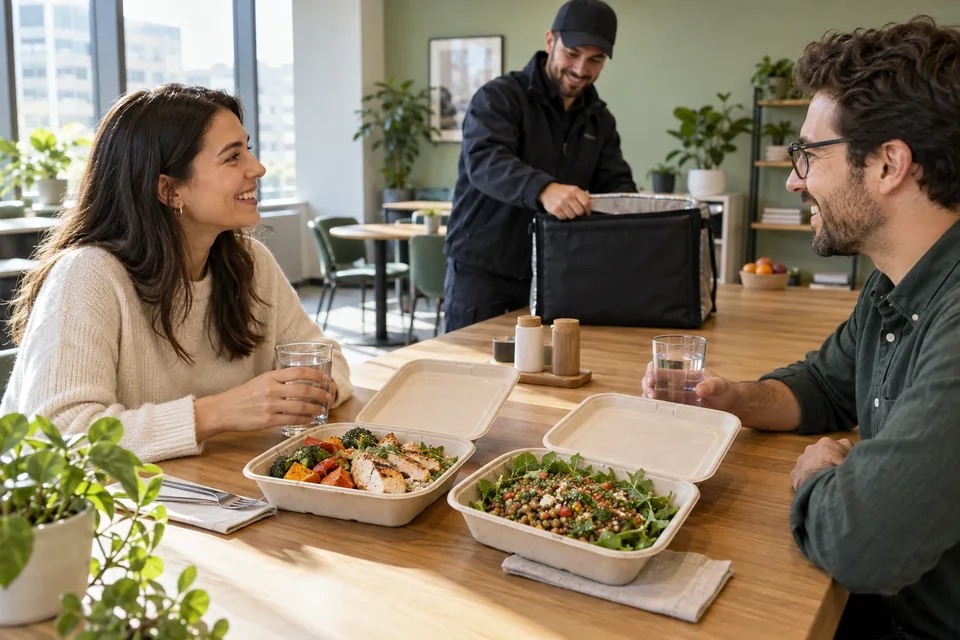
What office meal delivery means in practice
Office meal delivery means food ordered from a caterer, restaurant or specialist platform and brought to a workplace, whether that is an open-plan floor, a boardroom, a co-working space or a charity’s back office. The order can feed one person who is stuck at a desk or sixty people attending an all-day workshop. What sets it apart from ordinary takeaway is the handover: the food has to reach a building with reception rules, lifts and security passes, and it has to be ready when a meeting breaks, not when the courier happens to arrive.
Most orders fall into a few familiar situations. A working lunch with a client, a training day, a quarterly planning session, a leaving party, a new starter’s welcome breakfast and a late finish before a deadline all call for slightly different food and different timing. Some firms also set up weekly workplace catering, for example every Wednesday when many staff are in the building under a hybrid working pattern.
Because several people share one order, the person organising it carries a small amount of responsibility. Guessing wrongly about an allergy or turning up with too little food is noticed immediately, so a little preparation before ordering pays off more than the choice of dish.
Platters, hot buffets and boxes for office lunch delivery
Three formats cover most office meal delivery. Each suits a different type of gathering and a different level of formality.
- **Sandwich and wrap platters** are the default for short meetings. They arrive cold, can sit out for a while and need no equipment. The weak point is monotony: a platter of identical fillings gets tired quickly, so mixing breads and including a few salads helps.
- **Hot buffets** such as curries, pasta bakes or roast trays suit longer events and colder months. They usually need chafing dishes or an oven to hold temperature, and someone has to serve, so check what the supplier brings and what the office must provide.
- **Individual boxes** hold a complete meal per person, labelled with a name or a dietary tag. They cost more effort to specify but remove queueing, sharing of serving spoons and arguments about who took the last portion.
Breakfast and afternoon snack orders follow the same logic. Pastries, fruit and yoghurt pots work for a nine o’clock start, while cakes and biscuits tend to be the easiest afternoon addition. Meals delivered to the office often come with extras, and hot drinks in insulated carriers, often called tea and coffee boxes, are frequently sold as an add-on by caterers.
Team lunch delivery: taking one group order without missing anyone
The most common failure in a team order is not bad food but a bad list. A shared spreadsheet or a short message in the team chat works well, as long as it asks for three things: the person’s name, their choice and any allergy or dietary requirement. Setting a closing time well before the supplier’s cut-off avoids the late scramble.
A few habits make the collection smoother:
- Ask for the headcount, then add a small margin for people who join at the last minute, particularly for client meetings.
- Request that each individual box carries a name label, so the vegetarian does not have to open four lids to find hers.
- Nominate one person to receive the delivery and check it against the order before the courier leaves.
- Keep the confirmation email handy, since it usually names the supplier’s phone number for urgent changes.
When the order is for visitors, it is courteous to ask them about requirements in advance rather than hoping the mixed platter will cover everything. A short email asking "any dietary needs we should know about?" is enough and is welcomed far more than an awkward discovery at the table.
Allergies, diets and religious requirements for meals delivered to the office
A workplace gathers people with very different needs: vegetarians, vegans, coeliacs, people avoiding pork or non-halal meat, people with nut allergies. Under UK rules, food businesses must be able to tell customers when any of the 14 major allergens, including cereals containing gluten, milk, eggs, peanuts, tree nuts and sesame, are present in what they sell. A reputable caterer should therefore answer allergen questions in writing, and the organiser should keep that answer.
Two points deserve emphasis. First, "vegetarian" and "vegan" are not interchangeable: a quiche is vegetarian and is not vegan. Second, a dish labelled free from an ingredient is not automatically safe for someone with a severe allergy, because kitchens handle many ingredients. For serious allergies, the person concerned should speak to the supplier directly instead of relying on the organiser’s relay.
A sensible approach is to order a few clearly separate special meals in addition to the main platters, each labelled, rather than trying to make every dish suit everybody. Everyone eats well, and nobody is singled out.
Timing, access and the last hundred metres
Many office meal deliveries fail at the door. Couriers cannot find the right entrance, reception does not know the order exists, or the lift needs a pass. To avoid this, give the supplier the exact floor, a mobile number for the person receiving the food and any instructions about loading bays or visitor sign-in.
Timing needs a buffer. Food arriving fifteen minutes before a meeting starts is perfect; food arriving during a presentation is a nuisance, and food arriving an hour early needs refrigeration or a hot-hold. Large orders are usually produced in batches, so ask for a delivery window instead of an exact minute, and confirm it the day before.
On arrival, check temperature and contents straight away. Cold items should feel properly chilled, hot items should be steaming, and anything that looks wrong should be photographed and reported to the supplier at once, because complaints made on the day are far easier to resolve than those made a week later.
Budgets, expenses and who pays for lunch
Cost is where office meal delivery becomes awkward. Some employers pay for working lunches during training days and client meetings, others split the bill, and some offer a regular allowance. In the UK, whether a meal provided by an employer is taxable or not depends on circumstances, so the finance team or the employer’s tax adviser is the right source rather than a colleague’s memory. In other countries, such as Belgium or France, meal vouchers and employer contributions follow their own national schemes.
Whatever the arrangement, a few practical steps help. Ask the supplier for an itemised invoice with the company name, because expense systems often reject a card receipt with no detail. Agree a per-head ceiling before ordering, for instance an illustrative figure set by the department, and tell attendees what is covered so nobody is left guessing about drinks. Delivery and service charges, minimum order values and cancellation terms differ considerably between suppliers, so read them before committing to a large booking.
Caterers, restaurants and platforms: picking a supplier
Three kinds of supplier compete for office meal delivery contracts. Independent caterers and sandwich bars offer personal service and flexibility, which suits recurring orders. Restaurants can deliver impressive food for a single event but may not be set up for forty portions at once. Dedicated platforms for workplace catering and the corporate arms of big chains offer online ordering, account billing and consistent menus, which suits busy offices and finance departments.
Questions worth asking before choosing: how much notice is required, whether allergen information is available in writing, how late changes are handled, whether crockery and cutlery are supplied or disposable, and what happens if the delivery is late. Reviews from other businesses in the same area are often more useful than general star ratings, since they reflect punctuality at office addresses.
Start with a small team lunch delivery, perhaps for a team meeting, before booking a big event. The experience of that first delivery, from the quality of packaging to the courier’s communication, is the best predictor of how a supplier will behave when the stakes are higher.
Frequently asked questions
Who is responsible if the food arrives late for a meeting?
The contract is with the supplier, so a late delivery is first a matter for the caterer or platform that took the order. Keep the confirmation showing the agreed window, note the time of arrival and contact the supplier promptly. Many offer a credit or partial refund, but terms vary, so check the cancellation and lateness policy before booking.
How far ahead should office meal delivery for a large group be ordered?
Small orders can often be placed on the same morning, but anything for more than fifteen or twenty people usually needs at least a day or two of notice, and large events several days. Short notice can mean a limited menu, so the safest habit is to order as soon as the headcount is roughly known.
Can one office meal delivery order cover vegetarians, vegans and people avoiding certain meats?
Yes, provided the requirements are collected before ordering. Most caterers offer clearly labelled vegetarian, vegan and halal options, and many will pack them separately. Ask in writing how they prevent cross-contact and request ingredient lists for anyone with an allergy.
Is it acceptable to eat at a desk when lunch is delivered?
That depends on the workplace. Many employers encourage a proper break away from the screen, particularly for team lunches, while others are relaxed about it. Delivered food can make a short break easier to take, since nobody has to queue or leave the building.