
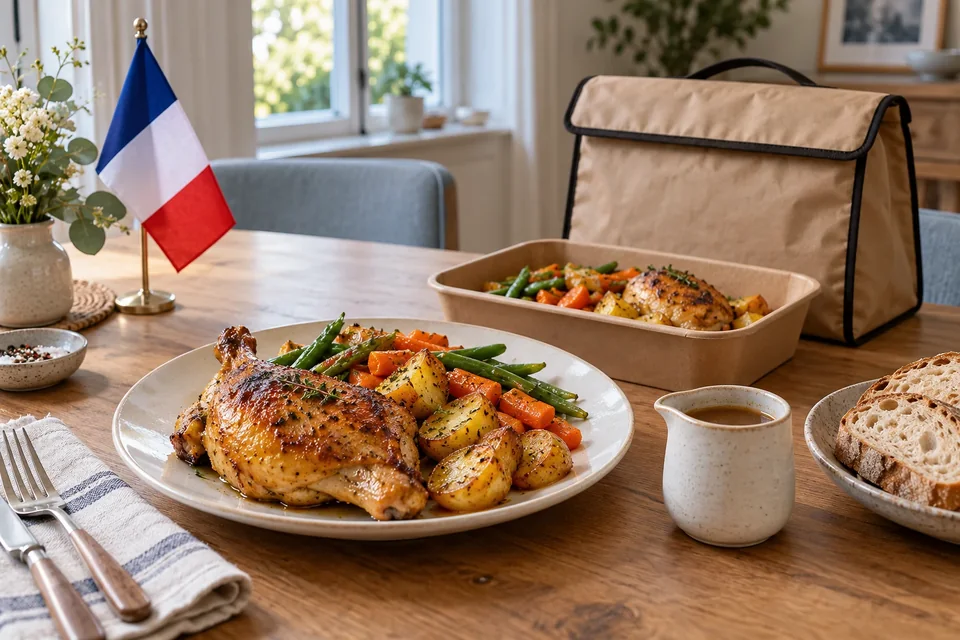
French food delivery: what the term covers
French food delivery means ordering dishes from the French culinary repertoire, from a bistro, restaurant, caterer, artisan producer or online grocer, and having them brought to your home hot or chilled. It stretches from a Sunday casserole in a tub to a multi-course dinner, via regional hampers prepared by small makers.
This cuisine has a feature that suits the van: it is built on slow cooking, reduced stocks and sauces that took hours. Beef bourguignon or a veal blanquette often tastes better after a night’s rest, while a deep-fried item or a risen soufflé collapses on the road. That explains why French food delivery works best with braised and baked dishes, and why French meal delivery from a good kitchen leans on stews, gratins and tarts.
The formats are varied: single dishes to reheat, daily menus, festive boxes, regional hampers and full catering with delivery and set-up. Some restaurants run a trimmed menu for takeaway, and some kitchens cook only for delivery.
Regional French dishes that make the journey
France is a patchwork of regional traditions, and each region has dishes that tolerate transport. A few signposts:
- South-west: cassoulet, duck confit and garbure, all slow-cooked in a pot and easy to reheat.
- Alsace and Lorraine: choucroute garnie, baeckeoffe, quiche lorraine and flammekueche. Sauerkraut is even better warmed gently.
- Burgundy and Lyon: bourguignon, coq au vin, quenelles in Nantua sauce and gratin dauphinois.
- Provence: daube, ratatouille, fish soup and vegetable tian. Bouillabaisse is a more delicate case.
- Savoie: tartiflette, crozets gratin and a fondue kit to assemble yourself.
- Brittany and Normandy: buckwheat galettes, cotriade, chicken in cider cream and apple tart.
A trustworthy supplier says where its recipes come from and where the main ingredients are sourced, whether poultry, beef, cheese or vegetables. That detail lets you compare two offers properly.
Casseroles, gratins and tarts: what French meal delivery handles best
In French meal delivery, as a rule, saucy dishes, gratins, soups, terrines, pâtés en croûte and savoury tarts survive a delivery without harm. Their texture barely depends on a few minutes in an insulated bag.
Other preparations are more fragile: pan-fried fish with an emulsified sauce, rare steak that must be eaten instantly, crisp green vegetables and assembled or frozen desserts. A serious caterer knows this and packs the sauce separately or leaves a two-minute finish for your kitchen.
Packaging counts as much as the recipe. Ovenproof cardboard trays, returnable glass jars and insulated bags with ice packs limit temperature swings. Ask how the dish arrives: hot by direct courier, or chilled with reheating instructions. In the UK and Ireland, the British takeaway tradition tends to deliver hot food within the hour, whereas French artisans more often send chilled meals by next-day courier.
Cheese, charcuterie and pastry: handling delicate parcels
Raw-milk cheeses, fresh goat’s cheese, soft rinds and sliced cured meats need a controlled temperature. A parcel left on a doorstep in the sun for several hours loses quality and can become a health risk.
Cream pastries, éclairs, fresh fruit tarts and layered desserts need cold storage, whereas viennoiseries and dry biscuits are more forgiving. If you are ordering for an event, state the preferred arrival time and clear fridge space before the van arrives.
Raw or lightly cooked products are riskier for pregnant women, young children, older adults and people with weakened immunity. A health professional can advise on what is suitable, and well-cooked dishes are usually the safer route.
Reheating and storing French dishes delivered at home
The basic routine for any French food delivery is to unpack, check the temperature and date, and put chilled items into the fridge quickly. A domestic fridge should stay at about 5°C or below for most perishable food.
To reheat, a gentle oven suits gratins and meat in sauce, a pan on medium heat suits stews, stirring now and then, and a microwave is fine for single portions in a suitable bowl. Whatever the method, the food must be properly hot all the way through before serving. Avoid reheating the same portion more than once.
Follow the use-by date printed on the label, and freeze a dish only if the supplier explicitly says it can be frozen.
Allergens and labels on delivered French cuisine
The UK and the EU require businesses to declare fourteen allergens: gluten, crustaceans, eggs, fish, peanuts, soybeans, milk, tree nuts, celery, mustard, sesame, sulphites, lupin and molluscs. In French cooking, milk, gluten, eggs, mustard and sulphites are almost everywhere, through butter, cream, flour, vinaigrettes and the wine in sauces.
A caterer offering French dishes delivered should provide the allergen list for each dish on the packaging or on request. If you have a severe allergy, say so when ordering and ask whether the kitchen also handles the ingredient you must avoid.
A home-made label is not a guarantee of anything. Only precise information about the recipe and the preparation is.
Choosing a French food delivery provider
Several criteria help when two French food delivery offers look similar. Start with the menu: clearly named dishes, identified ingredients and a short list of recipes beat a vast catalogue. Then check the delivery area, time slots, how heat or cold is maintained, and what happens when a delivery is late or damaged.
Useful questions: is the food cooked the same day? How long will it keep? Can a recipe be adapted for a diet? Is the meat French or local? How are returns handled?
Common mistakes include ordering a celebration meal at the last minute, having no fridge space, ignoring the reheating card or choosing from photographs alone. A small trial order on an ordinary evening tells you far more than a review ever will.
Frequently asked questions
Which French dishes are best for delivery?
Slow-cooked dishes, gratins, soups, terrines and savoury tarts: cassoulet, bourguignon, blanquette, choucroute and quiche. Dishes that must be eaten the second they are ready, such as soufflés or pan-fried fish, travel less well.
Can I freeze a delivered French ready meal?
Only if the label says so. Some sauced dishes freeze well and others do not. If unsure, follow the use-by date and the storage guidance supplied.
How do I know whether a dish contains allergens?
Fourteen allergens must be declared. Read the label or ask the supplier before ordering, especially for severe allergies to milk, gluten, eggs or nuts.
How far ahead should I order a party menu?
Allow several days as a minimum, and longer in busy periods. Lead times vary, so ask when you first make contact.