
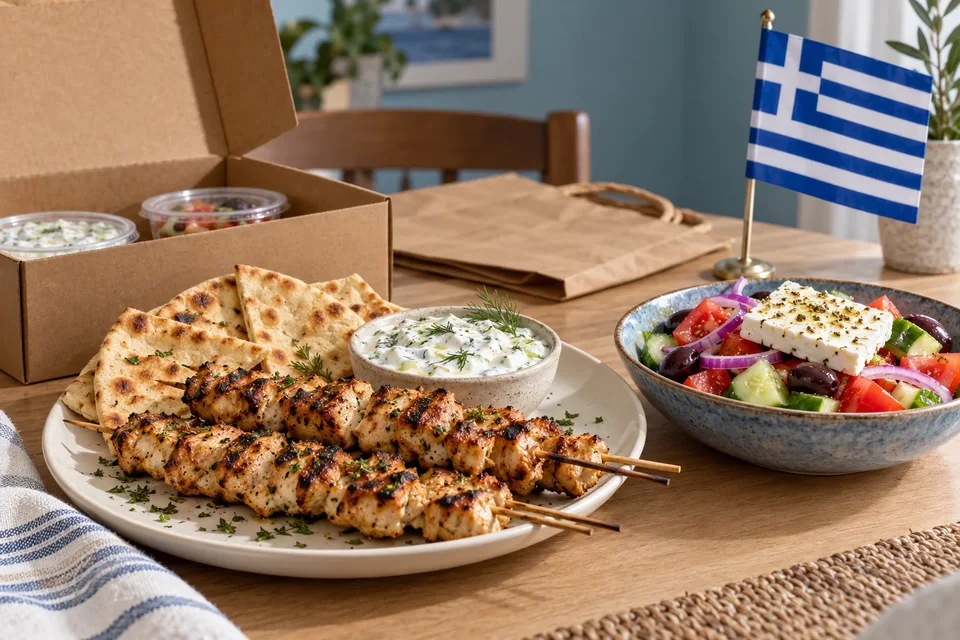
Greek food delivery: what arrives at your door
Greek food delivery means ordering dishes from Greece, cooked by a taverna, grill house, bakery, caterer or Greek delicatessen, and having them brought to your home ready to eat or ready to finish in your own oven. The usual order is a mix of cold dips, grilled meat in pitta, baked casseroles and something sweet with honey and nuts.
Greek food delivery draws on olive oil, lemon, oregano, tomatoes, aubergines, yoghurt, feta and charcoal-grilled meat. It is also food built for sharing, which suits a table of friends far better than a single sad foil tray.
In Britain and Ireland, the Greek and Greek Cypriot communities have run grill houses, bakeries and delis for generations, so a Greek takeaway is often a neighbourhood business rather than a chain. In North America, Greek diners and gyro counters play the same role. The quality of any Greek food delivery depends less on the country than on how the kitchen packs the food.
Greek meze delivered: dips, pies and stuffed vine leaves
Greek meze delivered in tubs and trays is the easiest order to get right, because most of it is happy to wait. Tzatziki (strained yoghurt, cucumber, garlic), melitzanosalata (smoked aubergine) and taramasalata (cured roe) are packed in tubs and served cold with warm pitta. Dolmades, vine leaves stuffed with rice and herbs, are eaten at room temperature, and keftedes, small herby meatballs, can be reheated in minutes.
Pies need a little care. Spanakopita (spinach and feta) and tiropita (cheese) are made with filo, which turns soft inside a closed box. Ten minutes in a hot oven brings back the crunch.
A balanced spread for four might be three dips, one baked pie, a tray of keftedes, a salad and a stack of pitta. Fried items such as courgette fritters or calamari are the weakest travellers: ask for them last out of the kitchen or accept that they will be softer than at the table.
Souvlaki delivery: gyros and grilled meat at home
Souvlaki is meat on a skewer, usually pork or chicken, grilled over charcoal. Gyros is meat cooked on a vertical spit and sliced thin. Both come wrapped in pitta with tomato, onion and tzatziki, often with chips tucked inside, or as a plate with rice and salad. For souvlaki delivery that stays juicy, ask for the bread, the sauce and the meat in separate compartments and assemble at home.
Pitta is the first thing to suffer on the road. A wrap that has steamed for half an hour tears. Warm the bread for a few seconds in a dry frying pan and it recovers its softness.
Two useful questions when ordering grilled dishes: - Is the meat cooked to order, or grilled earlier and held warm? - Can the sauces and salad come in pots so the wrap is built just before eating?
For a group, a platter of mixed skewers with salad and bread usually travels better than ten individual wraps.
Baked dishes that survive the journey: moussaka, pastitsio, gemista
Slow-baked Greek dishes delivered to the door are the safest bet of all. Moussaka layers aubergine, potato, spiced mince and béchamel; pastitsio is baked pasta with a meat sauce and béchamel; gemista are tomatoes and peppers stuffed with rice and herbs; giouvetsi is lamb or beef baked with orzo.
These dishes cope with a long ride and often taste better the next day. To reheat a portion, cover it with foil and give it about twenty minutes in a moderate oven, then uncover it for the last few minutes to colour the béchamel. A microwave is fine for a single slice, though the top will not brown.
Pulse dishes are equally reliable: gigantes plaki (butter beans baked in tomato), fasolada (white bean soup) and revithia (chickpeas baked slowly). Many are made without meat or dairy, a legacy of the fasting days of the Orthodox church, which makes them useful for vegan guests when the kitchen confirms the recipe.
Salads, feta and fish: handling the fresh side
A proper horiatiki, the village salad, has tomato, cucumber, red onion, olives, peppers and a slab of feta, but no lettuce. Delivered, it keeps best with the dressing in a separate pot, otherwise the vegetables weep and the cheese goes soggy.
Feta is a protected name in the European Union: it must be made from sheep’s milk, or sheep’s and goats’ milk, in designated regions of Greece. Labels in British shops may follow their own rules after Brexit, so check the packaging if the origin matters to you. Other Greek cheeses you may meet on a menu include halloumi from Cyprus, graviera and kefalotyri.
Fish and seafood, such as grilled octopus, sardines or fried squid, depend on a short, cold journey. If the delivery time is long or the weather is hot, choose the baked and stewed dishes instead and keep seafood for dining in.
Honey, filo and coffee: Greek sweets and drinks at home
Greek desserts lean on honey, walnuts and filo. Baklava is layered filo with chopped nuts and syrup; galaktoboureko is semolina custard wrapped in filo and soaked in syrup; loukoumades are small fried dough balls with honey and cinnamon that really want to be eaten within minutes. Thick Greek yoghurt with honey and walnuts is the simplest dessert to have delivered and needs no reheating.
Syrupy pastries keep for a few days, but they contain nuts, gluten, milk and often eggs, so mention allergies when ordering. Greek coffee is made in a small pot called a briki and served unfiltered, with the grounds settling at the bottom. Ouzo and tsipouro are aniseed or plain grape spirits taken with meze, and alcohol delivery is subject to the age checks of the country you live in.
Choosing a Greek takeaway: questions and allergy checks
A credible Greek food delivery provider writes the menu with real dish names, tells you what is made in-house and says clearly where it delivers and at what hours. Evenings and weekends matter most, since that is when a Greek meal is eaten. Greek dishes delivered cold and hot in the same bag need separate packaging.
Common allergens appear throughout the cuisine: gluten in pitta, filo and pasta; milk in feta, yoghurt and béchamel; eggs in moussaka and custard; nuts in baklava; sesame in some breads; fish and shellfish in taramasalata and seafood. Cross-contact is possible where one fryer or griddle serves everything. A "homemade" label is not an ingredients list, so ask for the full list when a guest has a serious allergy. Questions of that kind belong with the caterer and, for medical matters, with a doctor.
Vegetarians do well on a Greek menu through salads, stuffed vegetables, beans and pies, but check that stocks and mince are not hidden in dishes. If you eat no pork, ask what the souvlaki and gyros are made from.
For a first Greek food delivery, start small: a meze for two and one baked dish will show you the portion size and packaging before a family lunch or a party.
Frequently asked questions
Which Greek meze travel best?
Cold dips such as tzatziki and aubergine salad, stuffed vine leaves, meatballs and baked pies cope well with a journey. Fried items lose their crispness quickly.
How do I reheat a delivered moussaka?
Cover it with foil and warm it in a moderate oven for around twenty minutes, then uncover it briefly so the béchamel can colour. A single portion can go in the microwave.
What is the difference between gyros and souvlaki?
Souvlaki is pieces of meat grilled on a skewer, while gyros is meat cooked on a vertical spit and sliced thinly. Both are commonly served in pitta bread.
Is Greek food suitable for vegetarians?
Often yes, thanks to salads, stuffed vegetables, bean dishes and spinach pies. Check whether meat stock or mince is used in particular dishes.