
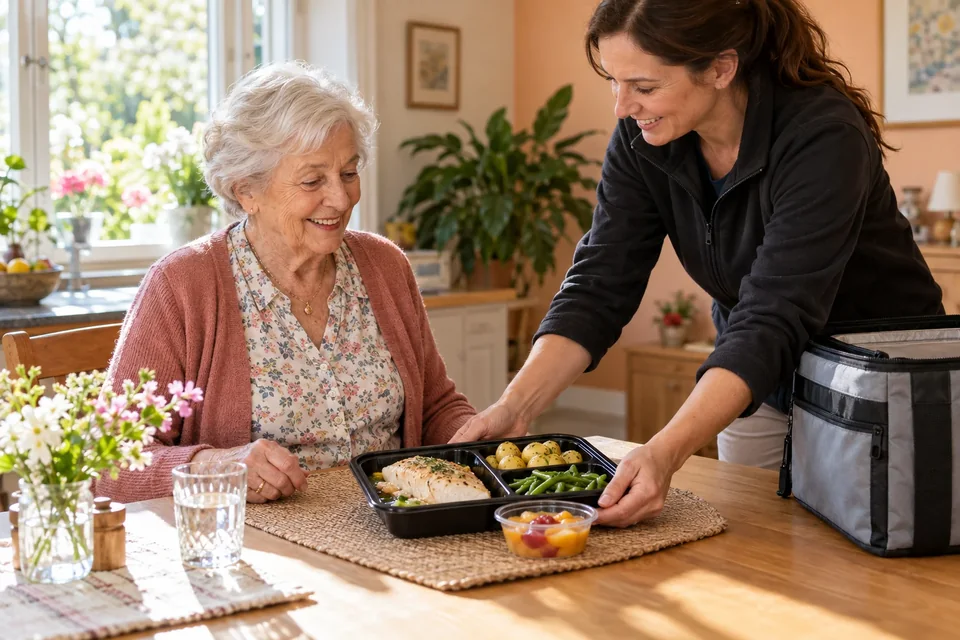
ADMR meal delivery: what the service is
ADMR meal delivery is a service offered by the local associations of a French home-care network whose initials originally stood for "Aide à Domicile en Milieu Rural", help at home in rural areas. On the national website it appears under the heading of meal and grocery delivery to the home, alongside other services for older people, people with disabilities and anyone who needs a hand at home.
The national presentation describes healthy, balanced meals prepared locally with fresh ingredients and delivered daily or on an occasional basis. It states that hygiene and safety standards apply from preparation through to transport. Drivers carry out the deliveries, and the same page mentions grocery and errand deliveries for people who cannot go out.
For a reader used to British meals on wheels, the closest comparison is a charity-run round, with a local team and a personal relationship between helper and client.
Why ADMR home meals differ from one area to another
ADMR meal delivery is organised in tiers. The network works through levels of responsibility. At the level closest to residents, a local association employs staff and often relies on volunteers. It belongs to a departmental federation, which in turn is part of the national union that sets general direction and the shared brand.
This structure explains the variations seen from one département to another. In one village the meals may be delivered by the association’s own team, and in the next they may be subcontracted to a caterer or a nearby communal kitchen. Round timetables, weekend meals and the diets offered therefore depend on the place.
To find out whether meals from ADMR exist in a given village, the national site offers a search for the nearest association, and a phone call confirms what is really available. Never assume that a service described nationally runs in every parish.
Who uses ADMR meal delivery and in which situations
The ADMR meal service is aimed mainly at people who cannot get about easily, temporarily or permanently, and who want food suited to their diet or habits. Typical clients include older people living alone, people with disabilities, tired family carers looking for a break and patients coming home from hospital.
The request can come from the person, a son or daughter, a neighbour or a health professional. The association then meets the person to understand the need before proposing a package covering delivery days, number of meals and diet.
- Return from hospital with temporary tiredness.
- Isolation in a rural hamlet with no shop nearby.
- A carer who needs a regular break from cooking.
- A long-term loss of mobility.
Enquiring and signing up with the local association
Registration for ADMR meal delivery normally takes place by phone or at the association’s office. The national website also holds an online quote form with meal delivery among the services that can be requested.
- Call the local association and describe the need.
- Receive an assessment visit or call.
- Obtain a quote or a detailed proposal covering meals and days.
- Sign the contract and settle how meals are handed over and how to cancel.
- Receive the first delivery.
Some associations need a lead time to set up the round, especially in holiday periods. It is wiser to plan ahead, above all before a hospital discharge, and to ask what happens when the usual driver is absent.
Costs and funding of ADMR home-delivered meals
Meal prices do not appear on the national page, which is normal because each association sets its own terms. The price of ADMR home-delivered meals has to be requested when the quote is drawn up, stating the number of meals, the days and any extras. A price quoted for example by another town means nothing for yours.
Several forms of help can ease the bill: the autonomy allowance paid by the département when the care plan provides for it, a pension-fund grant, the assistance of a mutual insurer, or a tax advantage on home services. The association can explain the steps and supply the certificates needed.
Keep each quote and invoice, and compare them over the same number of weeks if two associations are contacted. Ask also whether the price covers the delivery visit itself or whether a separate charge applies for each round. When help is expected, ask in advance whether the association invoices the full amount first or deducts anything directly.
ADMR or another meal delivery round: how to compare
Meals from ADMR are one option among several. Meals are also delivered through other channels: a town service, an intercommunal social centre or a private company. The comparison should rest on concrete criteria rather than on name recognition.
- Regular timings and a stable delivery team.
- Menu variety and food quality, which can be judged by tasting.
- Flexibility to pause or change formula.
- The option of combining other home services with the same contact.
The strength of a network association is its closeness and the chance to bring several kinds of help under one roof. Its possible limit is geographical coverage, since not every area has an association able to cook or deliver. A trial week with one provider, with a note of how the food arrives and how the delivery person behaves, then another, shows quickly which arrangement suits the household.
Frequently asked questions
Does ADMR deliver meals everywhere in France?
No. The ADMR meal service works through local associations, and the offer varies by area. The national website helps find the nearest one, and a call confirms whether meals are available.
Can I order meals for visitors as well?
The national presentation says extra meals for visitors can be ordered. The conditions and prices are set by the local association.
How much do ADMR meals cost?
No price appears on the national page. Each association sets its own, so the figure must be requested in a quote based on the number of meals and days.
Can meals follow a special diet?
The network says meals can be adapted to the diet of the person. What exactly is possible depends on the association’s kitchen, so state the diet when registering.