
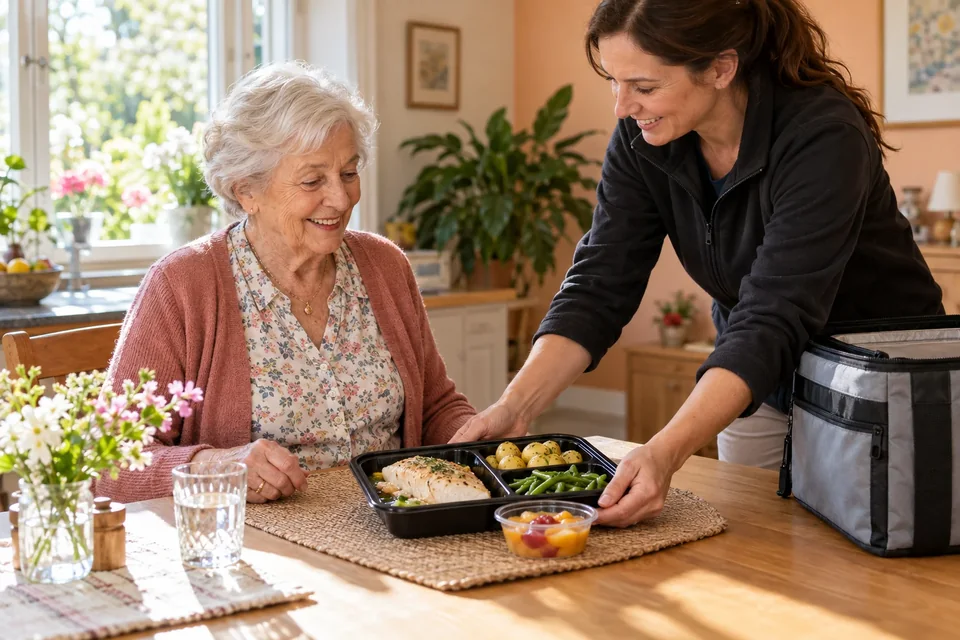
Senior meal delivery: what the term covers
Senior meal delivery means a regular supply of prepared meals brought to the home of an older person who finds shopping or cooking difficult. It covers several quite different services under one label. A council or charity may bring a hot lunch to the door in an insulated box. A commercial company may leave a week of frozen meals in a freezer-friendly bag. A local kitchen may drop off chilled dishes that only need reheating. The label on the packaging matters less than the answer to one question: who is eating, and what can they safely manage on their own?
Many people begin using the service after a hospital stay, a bereavement, a fall, or a gradual loss of energy that makes standing at the hob tiring. Others are carers at a distance who want to know that a parent living alone is eating something proper each day. Used well, the arrangement keeps an older person independent in their own home for longer, and the daily knock on the door can matter as much as the food.
Meals on wheels and other ways the food reaches the door
In the United Kingdom the phrase meals on wheels traditionally refers to hot meals delivered by local authorities or voluntary groups, often at lunchtime, to people who meet certain criteria. Availability has shrunk in many areas and differs from one council to the next, so the first call is usually to the adult social care department, which can explain what is offered locally and whether an assessment is needed.
Alongside the public service, several private routes exist:
- **Frozen meal companies** deliver by van on a set day. Meals are stored in the freezer and heated in the microwave or oven, which gives flexibility about when to eat.
- **Chilled meal services** bring fresh-prepared dishes with a short shelf life, and usually need a fridge and a more regular delivery rhythm.
- **Hot meal providers** such as local cafés, community kitchens and some care-home catering teams will cook and deliver a lunch to the neighbourhood.
- **Charitable lunch clubs and community cooks** sometimes deliver to neighbours who cannot get to the table in a church hall.
In Ireland, Canada and the United States, volunteer-run meals on wheels programmes are well established, often linked to local seniors’ centres or parish groups. Rules and waiting lists vary by region, and a local helpline can explain which one covers a given postcode or ZIP code.
Meals delivered to older people: appetite, loneliness and the pleasure of eating
Food for an older person is also a social event, and meals delivered to older people can bring company with them. Eating alone every day dulls appetite, and an unwatched plate often goes back to the fridge. A delivery that arrives at a predictable hour gives the day a shape, and a friendly driver who stays for a minute can notice a change in mood, a missed newspaper or a stumble.
Several small habits make the arrangement work better. A lunchtime main meal followed by a lighter supper, a pudding saved for the evening, or a small snack placed within easy reach all spread nutrition across the day. Using a favourite plate and laying a proper place at the table lifts the experience from a chore to a meal. Where possible, eat with a neighbour, relative or friend, even by telephone.
If someone stops finishing meals, loses weight without trying or seems unusually confused, tell their GP rather than assuming it is the menu. The delivery person is often the first to see these changes and a good provider has a procedure for raising concerns with a named contact.
Paying for home-delivered meals and finding financial help
Costs of senior meal delivery differ widely. Council meals are usually charged at a set price per meal, sometimes reduced after a financial assessment, while private frozen services charge per meal with minimum orders or delivery fees. Amounts change too often to quote reliably, so ask any provider for a written price list with all extras before the first order.
Help can come from several directions. A needs assessment from the local authority may identify food preparation as an area where support is available. Some charities and benefit-linked schemes, such as Attendance Allowance in Great Britain, are not specifically meant for meals but can be used by the person to pay for them, and an advice organisation like Age UK, Age Scotland or Age NI can explain eligibility. In other countries, health insurance, home-care programmes and tax credits may contribute; the details depend on national and regional rules, so a social worker or an official helpline is the best starting point.
Families who arrange the service on behalf of a relative should keep the order confirmations and set up payment by direct debit only with the older person’s consent.
Questions to ask a provider before the first order
Choosing a meal service for seniors calmly at the kitchen table is far better than agreeing on the doorstep. The following questions help separate a good service from a poor one:
- How many days a week do you deliver, and is there a delivery window that I can choose?
- Is there a minimum order, a contract, or a notice period if we want to stop?
- What happens if the driver finds no answer at the door, or the person has been taken ill?
- Can the menu be tailored for a texture need, a medical diet or a religious requirement?
- Are meals cooked from fresh ingredients, and is there a clear label with use-by date, ingredients, allergens and heating instructions?
- Can we taste a sample or order a trial week?
A reliable provider will respond clearly and without pressure. Be wary of anyone who insists on a long commitment, a large upfront payment or a decision on the same day.
Keeping meals safe at home: storage and reheating
Food safety is a particular concern in senior meal delivery, because older adults are more vulnerable to food poisoning. Chilled meals should go into the fridge as soon as they arrive and be eaten by the date on the pack. A fridge should be kept at 5 degrees Celsius or below. Frozen meals belong in the freezer straight away and should be defrosted only as directed on the label.
Reheating needs care. Dishes should be piping hot all the way through, with no cold patches, and stirred halfway if the instructions say so. Microwave ovens vary in power, so follow the timings on the pack and check the central temperature by eye and by touch with a clean spoon. Leftovers should be cooled quickly, covered and kept in the fridge, and a dish that has been reheated once should not be reheated again.
Dexterity can also be an issue: some trays are hard to peel, some boxes are heavy, and some labels are printed in tiny type. A supplier that offers easy-open packaging and large print instructions has understood its customers.
Frequently asked questions
Is meals on wheels still available everywhere in the UK?
No. It is a discretionary service in many areas, and some councils have scaled it back or stopped it, while others work with local charities or contracted companies. The adult social care team at the local council can say what exists in a specific area and whether an assessment is needed.
Can senior meal delivery be arranged for a parent who lives in another town?
Yes. Many private services deliver nationwide or regionally and accept orders from a relative, with payment made by the family or by the older person. It helps to agree on the delivery day, tell a neighbour and ask the provider how they will act if nobody answers the door.
Do frozen meals provide enough nutrition for older adults?
They can, provided the menu includes protein, vegetables and starchy foods and is suited to the person’s health needs. Check the nutritional information and any dietitian involvement, and talk to a GP or dietitian if the person has a medical condition, is losing weight or has difficulty swallowing.
What if the older person has dementia or forgets to eat?
Hot meals handed over at the door and eaten with company often work better than a freezer full of options that need decisions. Speak to the provider about simple packaging and clear instructions, and ask the local social care team about extra support at meal times.