
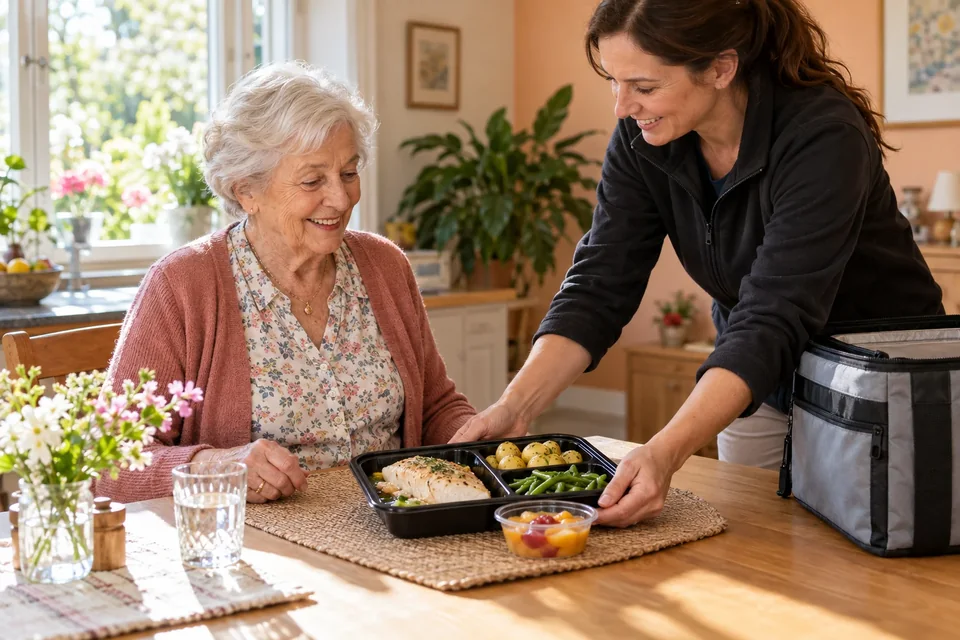
Meal assistance for older people: what counts as social help
Meal assistance for older people covers the public support that lets a senior eat properly at home when age, illness or a small income makes shopping and cooking hard. In France it does not take the shape of a universal meal voucher. It reaches people through general autonomy benefits, subsidised local services and discretionary grants decided by the town.
The idea covers very different situations. Someone on a modest income who is still independent will mainly look for a reduced price from the municipal meal round. A person who has lost autonomy will more probably look at a care plan funded by the département, where meal delivery sits beside other help. A third case is an emergency, such as a sudden illness, where a short-term grant may bridge the gap.
For an English-speaking family arranging this for a parent in France, the first task is simply to work out which of these situations applies.
Three yardsticks: income, autonomy and living situation
Offices that grant help with meals for older people look at three things. The first is household income, judged from the tax notice, pensions and sometimes savings or property. It decides the right to certain benefits and the share of the price the person pays.
The second is the degree of autonomy. Medical and social teams use a national grid that sorts people into groups from GIR 1, the heaviest dependence, to GIR 6, almost full independence. The personal autonomy allowance concerns people of 60 and over classed GIR 1 to 4.
The third is the living situation: living alone or with a partner, having relatives nearby, being isolated in a village, or being unable to leave the house. Two people with the same pension can therefore receive quite different answers.
- Income decides the price share and some entitlements.
- Autonomy decides eligibility for the allowance.
- Living situation shapes which service fits best.
The département’s role in senior meal assistance
In meal assistance for older people, the département leads local policy. It pays the personal autonomy allowance, handles requests for home social assistance from people with limited means and authorises and monitors home-care services.
The procedure for the allowance is precise. The request goes in online or on a form depending on the département, with proof of identity, tax and bank details. The département acknowledges receipt, a team visits the person, and a care plan is put forward where one is justified. The official page on this allowance lists transport and meal delivery among the help a plan may include.
The department must acknowledge a file within ten days and decide within two months of a complete request. The person then has ten days to accept the plan or ask for changes. Because the plan is built around needs, it is worth saying clearly that a hot or chilled meal each day is a priority.
The town’s social-action centre: the nearest door to knock on
The CCAS is the municipal public body that runs social action at local level. It handles claims for statutory social assistance, meaning those organised by law, and passes them on to the département or the State. It can also grant optional help, such as an emergency payment or food aid, which often makes up the core of local social policy.
For social support for senior meals, the CCAS acts in several ways. It sometimes runs its own delivery round, it signs an agreement with a charity or a provider, or it simply directs people towards the right scheme. In a small commune, the town hall secretary performs this role.
It is usually the best first call, because it knows which services cover which streets, and it can explain how to apply without any charge.
Documents and waiting times for senior meal assistance
For senior meal assistance financed by a grant, the usual file contains an identity document, proof of address, the latest tax notice, pension statements, bank details and, depending on the help, a medical certificate. The départemental allowance has its own form.
- Copy every document before sending.
- Send by tracked post or hand in against a receipt.
- Write down the date so you can chase the file.
Waiting times are counted in weeks. For the allowance, the public administration indicates an acknowledgement within ten days and a decision within two months of a complete file. Municipal services can sometimes be faster, but nothing should be taken for granted, so ask for a start date in writing and plan a stop-gap for the first weeks, such as a relative or a neighbour.
Meals for older people: delivery, lunch clubs or help with cooking
Meal assistance for older people is not limited to delivery. A home helper or care worker can shop and prepare a meal on the spot, which keeps the habit of cooking alive. A lunch at a seniors’ restaurant or an independent-living residence offers a shared meal, often at a regulated price, with transport sometimes organised.
Delivery suits people who can no longer travel or cook, or who want to stay independent without calling on a relative each day. It also brings a regular visit, which is useful for isolated people.
Formulas can be combined. For example, delivered lunches on weekdays can be matched with a shared meal at a club on Sunday, and a helper can handle the shopping. A social worker can build that mix with the person, according to their wishes and their budget.
When meal help for seniors is refused or falls short
A refusal, or help that seems too small, is not necessarily final. When meal help for seniors is refused, the decision must be reasoned in writing and must say what routes of appeal exist. The first step is to ask the deciding body for an explanation, then complete the file if a document was missing.
An informal appeal to the authority that decided is possible, as is an appeal to the competent commission or court within the time limit stated in the notification letter. A social worker, a local information point or an organisation defending older people can accompany these steps.
Meanwhile, other sources of funding can be tried, including pension-fund assistance, insurer cover and the town’s own discretionary aid. Keep every letter and note each call, since a well-documented file is far easier to defend if meals for older people are still not covered after the first answer.
Frequently asked questions
Is there a national meal allowance for older people in France?
No. Support is made up of general autonomy benefits, subsidised local services and optional help from towns, so the route depends on income, autonomy and where the person lives.
Which age and level of autonomy does the APA require?
The allowance is for people aged 60 or over classed GIR 1 to 4. A department team assesses the level at home.
Where should a family start?
The town’s social-action centre or the town hall is a good first stop, since it knows the local services and can explain the next steps.
What if the request is turned down?
The decision has to be explained in writing with the appeal routes. A person can ask for clarification, add missing papers or lodge an appeal within the stated time.