
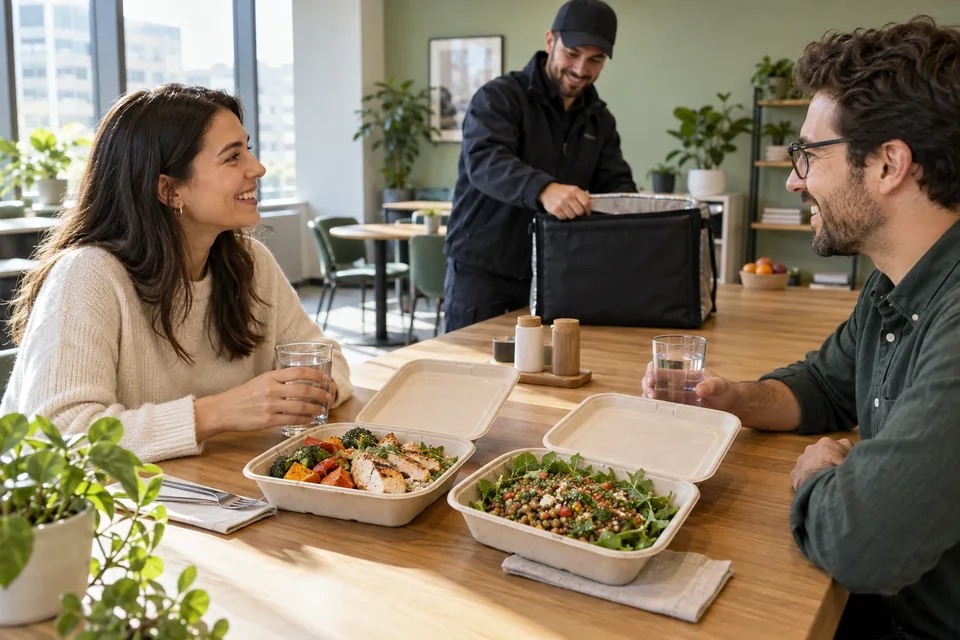
Meal delivery in New York: what the five boroughs offer
Meal delivery in New York means every service that brings a prepared meal to an apartment, office or hotel room in the five boroughs: Manhattan, Brooklyn, Queens, the Bronx and Staten Island. The word delivery is as much part of daily life as the subway, and most restaurants, delis and even corner groceries take orders to go or to be brought over.
Visitors and new residents both lean on meal delivery in New York, which explains why the market is so crowded and why the same restaurant often appears on three apps at once.
The abundance follows from the shape of the city. Flats are small, kitchens sometimes tiny, working hours long, and dozens of different cuisines sit within a few blocks. Ordering in rather than cooking is no treat; it is a settled habit, on weeknights and on Sunday evenings alike.
Three realities structure the offer: ordering apps, restaurants that run their own riders, and services for older or isolated people. Each follows its own customs, and food delivery in New York looks different from one neighbourhood to the next.
Apps and deliveristas: who really brings the food
Several apps dominate the market, among them Seamless, Grubhub, DoorDash and Uber Eats. They offer menus, photos, live tracking and promotions, but they add delivery and service fees to the price of the dishes, so compare the final total rather than the price printed beside the dish.
Plenty of restaurants still keep their own riders, especially in areas where people have always phoned in. Calling directly can bring flexibility: a modified dish, an entry code, a precise time. Many pizzerias, Chinese restaurants and diners work this way.
The riders, nicknamed deliveristas, mostly travel on electric bikes, sometimes scooters, in all weather. Tipping is customary, in the app or in cash at the door. A reasonable amount is the rule, raised in bad weather or for a long trip.
Doormen, buzzers and walk-ups: receiving your order
How a meal reaches you depends on the building. In a doorman building the rider often leaves the bag at the desk and the doorman calls the resident. With an intercom you press the buzzer to open the lobby door. In a walk-up, a building without a lift, you may need to come down to the street, especially from the fifth floor.
Give a complete address: street number, name of the avenue or street, apartment number, floor and an access code if needed. A wrong apartment number is the most common cause of a missed handover. Many apps let you add an instruction such as ring twice or leave with the doorman.
Contactless drop-off, where the rider leaves the order and sends a photo, is widespread. It suits people with reduced mobility or families with small children, as long as someone is free to collect the food quickly.
Bagels, pizza, halal carts and delis: what comes to the door
New York cooking is a patchwork of immigrations. For breakfast the bagel with cream cheese, sometimes with smoked salmon, is the landmark. At lunch a slice of pizza and a deli sandwich with pastrami or corned beef feed the offices. In the evening local Chinese restaurants and their fried rice go out across the whole city.
Halal street carts popularised chicken and rice with white and hot sauce, now delivered by several chains. Queens gathers cuisines from everywhere: Indian, Nepali and Colombian in Jackson Heights, northern Chinese dumplings and noodles in Flushing, Greek tradition in Astoria.
Brooklyn offers Caribbean dishes, including jerk chicken, roti and doubles, and traditional Jewish cooking. Washington Heights, in upper Manhattan, is known for Dominican food, from mangú to rice and beans. Braised and grilled dishes survive the trip; delicate fried food and dressed salads suffer.
Kosher, halal, plant-based and allergy-friendly orders
New York is among the easiest cities in which to get kosher and halal takeout. Brooklyn neighbourhoods such as Crown Heights and Williamsburg hold many kosher shops, and halal butchers appear in nearly every borough. For a kosher meal, ask for the name of the supervising body and check that the kitchen does not mix meat and dairy.
Plant-based and gluten-free options have multiplied, from pizza on alternative bases to grain bowls. Restaurants increasingly list allergens, but the information is uneven, so state an allergy in the comments box and, if the risk is serious, call before ordering.
No meal provider can replace the advice of a doctor or dietitian for a diet linked to illness. When in doubt, choose a simple dish whose ingredients are easy to check rather than an unfamiliar speciality.
Meals delivered to older New Yorkers
For older people who can no longer cook or go out, assistance exists. The charity Citymeals on Wheels brings meals and companionship to older New Yorkers confined to their homes, and a relative can ask for someone to be enrolled. City services for older people point towards meals delivered, with criteria that depend on age, situation and where the person lives.
These programmes answer a different need from mainstream apps: reliable timing, balanced menus, diet adaptation and the regular visit of a familiar face. They also reassure families living far away who want to know a parent is eating properly.
For those who do not qualify, private prepared-meal companies deliver weekly trays, and some restaurants offer regular plans for older customers. Always ask about cancellation terms and how the provider handles absences.
Weather, rush hours and fees: ordering food delivery in New York
First-timers often find meal delivery in New York cheaper in effort than expected and dearer in fees than expected, so a few habits help.
Climate matters in a city that orders so often. In winter snow and ice slow the riders and a meal may arrive later than promised; in summer humidity and heat call for well-closed packaging and cold drinks. Big storms sometimes close venues or suspend delivery in some sectors.
Peaks come around noon on weekdays, between six and eight in the evening, and on Sunday at brunch time. Ordering then lengthens waits and can raise fees. A scheduled order, or one placed off-peak, avoids the queue and gives the kitchen time to prepare it properly.
Holidays disrupt the calendar too. At Thanksgiving, Christmas or New Year many restaurants close or limit service, while caterers sell complete meals to book ahead, so start days earlier.
On a first order, read the total line: dishes, delivery fee, service fee, sales tax and tip. For example, a modestly priced dish can end up noticeably dearer once these are added. Check the minimum order too, which differs between restaurants.
The usual mistakes are an incomplete address, a forgotten apartment number, no entry instruction, a phone switched off at delivery time and an unflagged allergy. Keep a reachable number and watch the tracking, because the rider may call if the entrance is hard to find.
Visitors should choose a restaurant near the hotel, check that the front desk accepts food deliveries and remember that some businesses do not take foreign cards without fees. A few English words are enough: delivery, no onions please, leave it at the front desk.
Frequently asked questions
How does meal delivery in New York work for a tourist?
Order through an app or by phone, give the hotel address with the room number, then collect the meal from the front desk. Tipping the rider is customary.
Which apps are used most in New York?
Seamless, Grubhub, DoorDash and Uber Eats are widespread. Many restaurants also take orders directly by phone or on their own website.
Can I get kosher or halal meals delivered?
Yes, the choice is large, notably in Brooklyn and Queens. Ask for the certifying body or the source of the meat and confirm that the kitchen follows the rules you need.
Is there a meal service for older people in New York?
Yes. Organisations such as Citymeals on Wheels and the city’s services for older adults point towards home-delivered meals, depending on age, situation and where the person lives.