
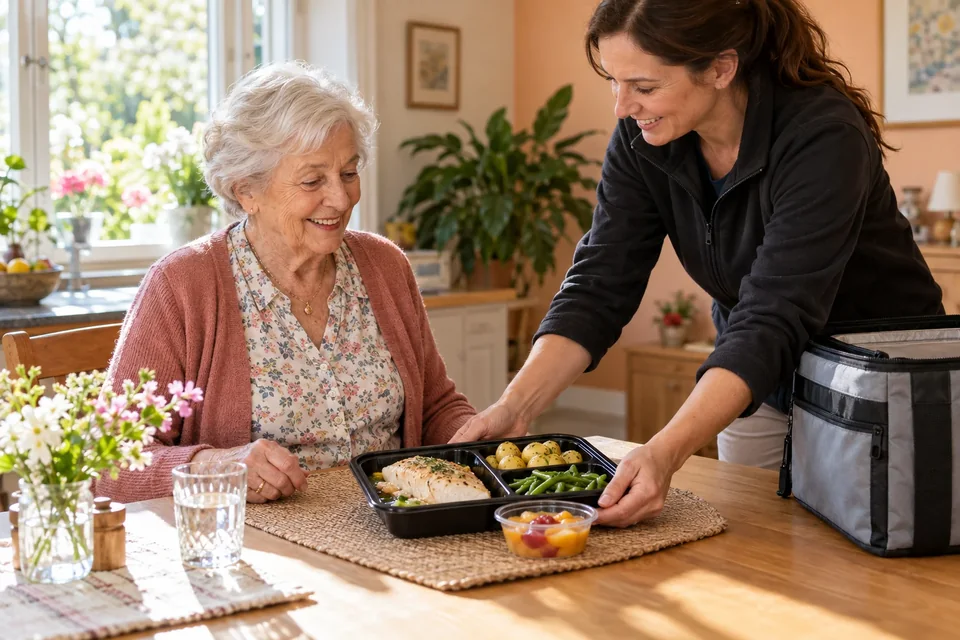
Meal delivery in Geneva: two worlds under one phrase
Meal delivery in Geneva means every solution that brings a ready-to-eat meal to your door, in the City of Geneva and the other communes of the canton. Two very different worlds sit under that phrase. On one side is the home-support service for people who can no longer prepare their meals for health reasons. On the other is commercial ordering: restaurants, caterers and platforms that deliver a dish of the day, a pizza or a festive menu.
The first answers a daily, regular need, with menus designed by dietitians. The second answers a craving or a lack of time, with a very wide choice but no nutritional follow-up. Knowing which of the two your need belongs to avoids disappointment and sends you to the right contact from the first call.
Meal delivery in Geneva has a particular setting: a compact, dense city where distances are short between the left bank, the right bank and the ring of urban communes. That density suits bikes and scooters, but it complicates parking for delivery vehicles in some districts, which affects the delivery times on offer.
Meals on wheels in Geneva: the imad service and who can use it
The Geneva home-care institution, imad, runs the best-known meals on wheels in Geneva: a meal service a meal service for people unable to cook for health reasons. It is reserved for residents of the canton. An assessment is carried out when the request is made, so the service cannot be obtained like a simple online order.
The meals are devised by the kitchen of the HUG, the Geneva University Hospitals, together with imad’s dietitians. Each meal includes at least two local, seasonal products carrying the GRTA label, the Genève Région Terre Avenir guarantee mark. For people who struggle to chew or swallow, three textures exist: sliced meat, minced meat or a blended meal.
Delivery runs from Monday to Friday between 8.30 am and 12.30 pm, with no fixed visiting time. Weekend meals are handed over on Friday. The frequency is chosen according to your wishes, and a cancellation can be made by telephone 48 hours before delivery. These services are not covered by basic health insurance. The nutrition service answers by phone on weekdays and is the contact to start a request.
Special diets and allergies: what the service allows
The imad home meal can be adapted to several health situations: meat-free or vegetarian, digestive-sparing, diabetic, lactose-free, gluten-free, salt-free or residue-free menus. A medical certificate is requested for the lactose-free, gluten-free and salt-free options. It is also possible to state tastes, for example fish one to three times a week, or dislikes such as pork, fish or lamb.
One point deserves your full attention: the meals cannot be delivered to people who are allergic to certain foods. A central kitchen preparing hundreds of meals cannot guarantee the absence of traces. If you have a proven allergy, say so at the first contact and, where relevant, turn to a caterer in Geneva who cooks to order and will describe the ingredients precisely.
That rule holds for all meal delivery in Geneva, whoever the provider. For any medical question, speak to your doctor or a dietitian: only a health professional can say which diet suits you.
Left bank, right bank and communes: how geography shapes orders
Geography conditions the success of an order. On the left bank, Eaux-Vives, Champel and Plainpalais gather neighbourhood restaurants and bakeries that readily deliver on foot or by bike. On the right bank, Pâquis, Saint-Jean and Servette are more working-class, with a very varied offer of world cuisines, from Lebanese to Ethiopian specialities.
Beyond the city, urban communes such as Carouge, Lancy, Onex, Vernier and Meyrin have their own shops. In Carouge, the lanes, which feel like a Sardinian town, are pedestrianised in places, and couriers arrive on foot from a drop-off point. Towards the Geneva countryside, delivery becomes rarer and dearer; a local caterer, a farm with direct sales or a meal service remain the best option.
State the floor, the intercom and a reliable phone number. In the older buildings of Pâquis or the old town, a doorbell that cannot be found is enough to send a cooling dish back.
Genevan specialities and what survives the box
The canton has a repertoire of its own. The Genevan cardoon, baked in a gratin, appears mostly in autumn and around the festive season. Longeole, a pork sausage with cumin, is eaten with lentils or cabbage. Fillets of Lake Geneva perch feature on the menu of many lakeside restaurants. For dessert, tarte au vin cuit or local prunes return in seasonal menus.
They do not all stand up to transport equally. A gratin and a simmered sausage reheat well in the oven or a pan. Fried perch fillets soften in the box within minutes, so it is better to eat them on the spot or order a poached or baked version. Always ask whether the dish arrives hot, lukewarm or ready to reheat, and what storage time is advised.
The Plainpalais and Rive markets are a serious alternative for fresh produce: some market gardeners take orders and deliver in their area, letting you assemble a meal without long cooking.
Food delivery in Geneva: restaurants, platforms and timing
On the commercial side, platforms such as Uber Eats and Just Eat operate in Geneva, in addition to the direct deliveries many restaurants offer. Restaurants generally run a lunch service and an evening service; deliveries bunch between 11.30 am and 1.30 pm, then from 6.30 pm.
A few practical points apply across Switzerland: service is included in the bill, tipping is a thank-you rather than an obligation, and rounding up to the next franc is common. For alcohol, beer and wine may be sold from age 16 and spirits from 18, so a rider may ask for ID at the door.
In winter, the bise, the cold dry wind blowing over the lake, chills a dish carried by bike quickly. When the bise blows, choose a nearby restaurant and an insulated container.
Escalade, family lunches and receptions
The Escalade, celebrated in mid-December, punctuates Geneva life: vegetable soup, the chocolate marmite filled with marzipan and the historic procession. Bakeries and caterers offer assortments that must be reserved several days ahead, because demand is concentrated on one weekend.
For a family meal or a small reception at home, a caterer in Geneva can prepare hot dishes delivered in trays, with reheating instructions. Ask about the ordering deadline, the minimum number of covers, the allergen list and whether the menu can be adapted for guests on a diet.
For a large reception, a private chef who cooks on site is more flexible but needs an equipped kitchen.
Questions to ask before ordering
Whether you want a regular service or one-off meal delivery in Geneva, the same reflexes protect your comfort and food safety. Who prepares the dishes, and where? A central kitchen, an independent caterer and a restaurant do not offer the same guarantees. How are the dishes kept, and at what temperature do they arrive? How long can they be kept after delivery, and how should they be reheated? Are allergens listed dish by dish? What happens in case of absence or cancellation, and what notice is needed?
For home-delivered meals in Geneva, avoid committing for several weeks without having tasted and without knowing the terms for stopping. A trial of a few days lets you judge quality, punctuality and portion size.
Frequently asked questions
Who can get imad home meals?
The service is for residents of the canton of Geneva who cannot cook for health reasons. An assessment is made at the time of the request, and the meals are not reimbursed by basic health insurance.
When are the imad meals delivered?
Monday to Friday, between 8.30 am and 12.30 pm, with no precise time of visit. For Saturday and Sunday, the meals arrive on the Friday. To cancel, phone 48 hours ahead.
Can I have a gluten-free or lactose-free meal delivered?
imad offers these menus on presentation of a medical certificate. For a proven allergy, mention it from the start: a central kitchen cannot always guarantee the absence of traces.
How does it differ from a delivery platform?
A platform delivers a restaurant’s order, with no dietary follow-up or regularity. The home-support service provides balanced meals adapted to your health, on a regular basis.