
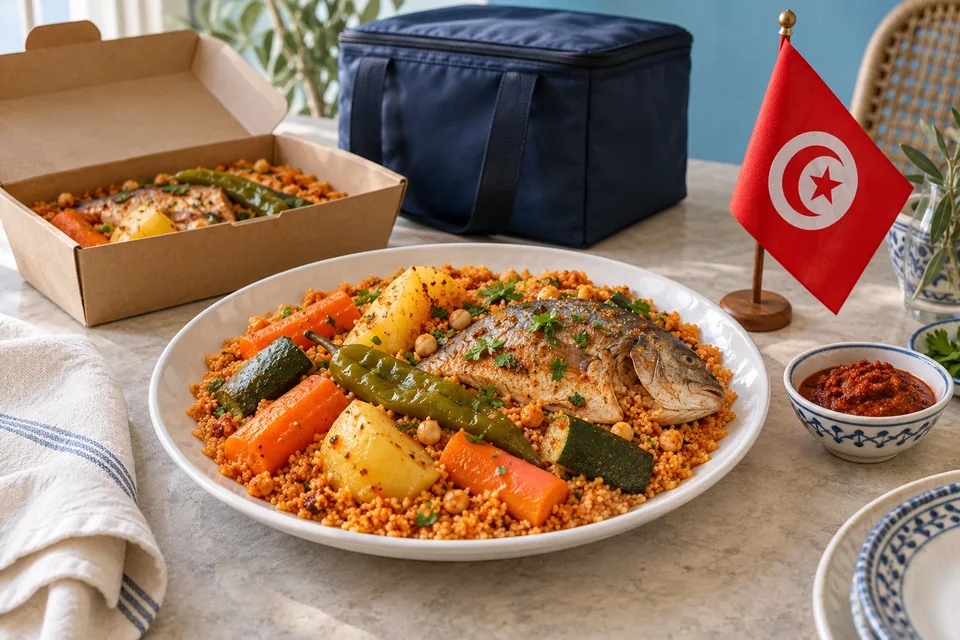
Tunisian food delivery: what arrives at the door
Tunisian food delivery means having traditional dishes from Tunisia cooked by a restaurant, a caterer or a home cook and brought to your address, hot or ready to reheat. The cooking sits between the Mediterranean and the Sahara, so olive oil, tomatoes, peppers, preserved lemon, caraway, coriander and chilli run through almost everything, and harissa, the red chilli paste with garlic, is usually on the table or in the pot.
Tunisian meals at home are rarely a single dish. A typical order combines something crisp to start, a stew or couscous as the centrepiece, a salad to cool things down and a sweet to finish. That structure matters when you are choosing, because each part travels differently and each needs its own handling once the bag is on your kitchen counter.
The influences are layered: Berber and Arab foundations, Ottoman and Andalusian touches, plus Italian and French habits from the twentieth century. You can taste this in the pasta served with fish sauce, the tuna that appears in pastry and salads, and the pastries soaked in syrup. Coastal cities lean towards seafood, while the interior favours lamb, wheat and dates.
Brik, fricassé and salads: Tunisian takeaway starters that need care
The best-known starter is brik, a thin sheet of malsouka pastry folded around egg, tuna, capers and parsley, then deep-fried. It is at its best within minutes of leaving the fryer. If it arrives soft, a short spell in a hot oven on a rack brings back most of the crunch; the microwave does the opposite.
Fricassé is a small fried bun filled with tuna, olives, egg and harissa, a lunchtime street snack that works well as a shared platter. Salade méchouia blends grilled peppers, tomatoes and chillies crushed with olive oil, while the plain Tunisian salad adds cucumber, mint and olives. Cold dishes like these are the easiest items on a Tunisian takeaway menu, since they only improve while they wait.
When ordering several fried items for a longer journey, ask the kitchen to pack them in a vented box with paper, not sealed foil. Condensation is the enemy of anything built on thin pastry.
Couscous, ojja and lablabi: main courses for Tunisian meals at home
Couscous is the centrepiece of Tunisian meals at home, and the Tunisian version tends to be red from chilli and tomato, served with vegetables, chickpeas and lamb, or with fish on the coast. A good Tunisian takeaway packs the grain separately from the broth, because semolina left sitting in liquid turns heavy within the hour.
Ojja is a spicy tomato and pepper base in which eggs are set, often with merguez sausage or prawns. Lablabi is a chickpea soup flavoured with cumin and garlic, poured over stale bread and topped with egg and tuna; it suits a cold evening far better than a hot afternoon. Mloukhia is a dark, slow-cooked stew of corchorus leaves with meat, which keeps well and tastes deeper the next day.
Do not be misled by the word tagine. In Tunisia it describes a baked, quiche-like dish of eggs, cheese and meat, not the conical-pot stew known from Morocco. If a menu lists both, ask which one is meant.
Grills, seafood and the everyday table
Beyond the famous plates, the home table is built on grilled meats, fish in tomato sauce and seasonal vegetable stews. Delivered Tunisian dishes from the grill, such as lamb chops, merguez, chicken with lemon and garlic and mixed skewers all travel well if the meat is packed away from any salad, so juices do not soak the greens.
Seafood needs more attention. Calamari, prawns and whole fish should arrive cold-chain safe or hot, and be eaten the same day. The most sensible Tunisian food delivery order for two might be one grilled dish, one stew, bread and two salads, rather than three heavy items competing with each other.
Kafteji mixes fried vegetables with scrambled egg, and chakchouka is a pepper and tomato stew with eggs, both easy to reheat gently in a pan. Ask for the harissa in a small pot on the side so each person sets their own heat.
Makroud, baklawa and other sweet delivered Tunisian dishes
Tunisian pastry is fragrant and sticky. Makroud, a diamond of semolina dough filled with date paste, is the speciality of Kairouan and may be fried or baked, sometimes glazed with honey. Tunisian baklawa is smaller than the Turkish kind and usually uses almonds or pistachios, while zlabia are fried spirals dipped in syrup.
Assida zgougou, a pudding made from Aleppo pine seeds, is traditionally linked to the Mawlid celebration. Mint tea with a few pine nuts floating on top is the classic partner for any of these sweets.
Pastries are the most forgiving part of any Tunisian food delivery. Kept in a closed tin away from damp, most last several days, which makes them a handy gift or an easy addition to a first order.
Heat, allergens, halal meat and safe storage
Harissa varies enormously between cooks. One kitchen makes a smoky, mellow paste; another produces something that makes eyes water. Before paying, ask for the heat level of each dish and request the sauce on the side, especially with children, older relatives or anyone who normally avoids spicy food.
Olive oil is generous and so is salt, through olives, preserved lemon, capers and tinned tuna. To lighten a meal, ask for sauces separately, choose grilled rather than fried dishes and add plain yoghurt, raw vegetables and fresh bread, which soften the effect of a very hot plate.
If a household member follows a medical diet, speak to a doctor or dietitian first and then give the kitchen precise instructions; a caterer cannot adapt a recipe safely without clear information.
Several major allergens are built into the cuisine: gluten in semolina, bread and brik pastry; egg in brik, ojja and tagine; fish and shellfish; sesame; and nuts in the desserts. Celery and mustard can hide in marinades. In the UK and across the EU, a food business has to be able to tell you which of the 14 listed allergens a dish contains, so ask before you order and repeat the information when the food arrives.
Many Tunisian restaurants and caterers use halal meat, but it is not guaranteed, so confirm it each time. Cooked dishes should go into the fridge within about an hour or two of arriving, and be reheated until steaming hot throughout. Fish dishes should not be kept long.
Choosing a Tunisian caterer: questions worth asking
A reliable Tunisian caterer will answer simple questions without hesitation. Are the briks fried to order? Is the harissa homemade, and is it mild or fierce? Where does the fish come from? How much semolina and sauce is included per person? Is there an egg-free or nut-free choice?
Be wary of menus that mix every North African dish together without naming where the recipes come from, and of offers so cheap that portions must be tiny. A serious cook asks how many people are eating, whether children are present and whether anyone has allergies before suggesting a menu.
For Ramadan, weddings and family celebrations, book your Tunisian caterer early. Demand spikes, and the more elaborate dishes are often prepared in limited batches.
Frequently asked questions
Will a delivered brik stay crunchy?
Not for long. Brik is best eaten straight from the fryer, so ask for vented packaging and re-crisp it for a few minutes in a hot oven on a rack. Avoid the microwave, which makes the pastry limp.
Can I ask for milder harissa?
Yes. Most kitchens will serve harissa in a separate pot or reduce the chilli in the stew. Say how hot you want it when ordering, because the paste differs a great deal from cook to cook.
Is Tunisian tagine the same as the Moroccan dish?
No. The Tunisian tagine is a baked, firm dish of eggs, cheese and meat or vegetables, similar to a thick quiche. The Moroccan tagine is a slow-cooked stew named after its conical clay pot.
Which Tunisian dishes work without meat?
Ojja with eggs, lablabi without tuna if requested, salade méchouia, chakchouka, vegetable couscous and date pastries all suit a meat-free order. Always confirm that the broth and the harissa contain no meat stock or anchovy.