
Egyptian food delivery: a cuisine of pulses, rice and shared plates
Egyptian food delivery means ordering dishes from Egypt, cooked by a restaurant, a caterer or a home cook, and brought to your door in containers designed to survive the trip. The cooking rests on beans, lentils, rice, fresh herbs, flatbread and stuffed vegetables, and a great deal of it happens to be vegetarian, partly because the Coptic Christian calendar includes long fasting periods when meat and dairy are set aside.
The Nile valley fed Egypt with wheat, fava beans and vegetables for thousands of years, and everyday food still follows that pattern. Cairo’s style is hearty and cheap; Alexandria looks to the sea; Upper Egypt keeps rural recipes with pigeon, rice and cracked wheat; Nubia adds its own spices.
For many readers, Egyptian meals at home will be a discovery. The food is plain in the best sense: filling, savoury, rarely fiery, and built to be shared across a table with bread in the middle.
Koshari: assembling Egypt’s national dish after delivery
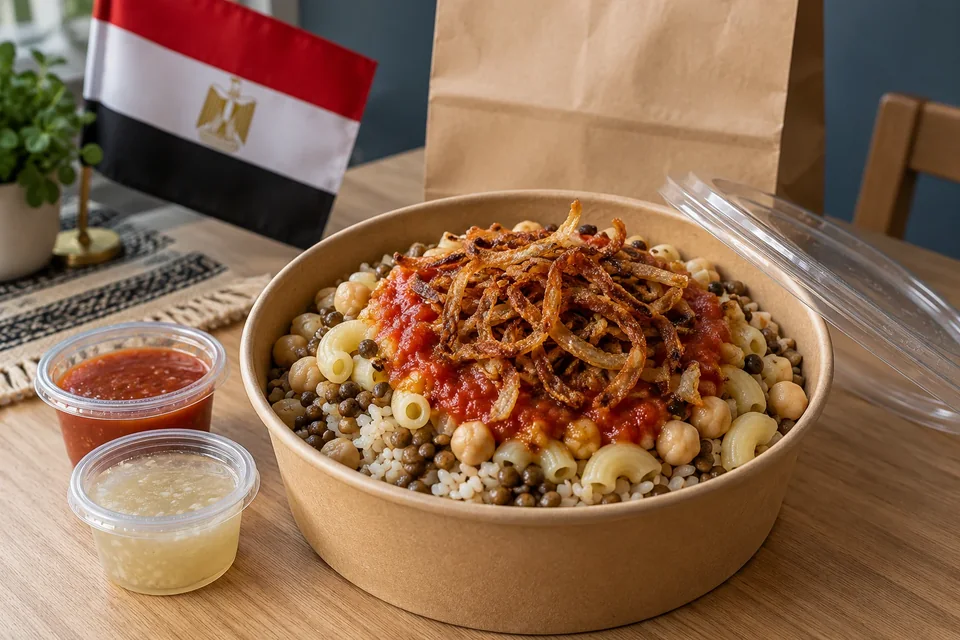
Koshari (also spelled koshary) piles rice, brown lentils, macaroni, chickpeas, spiced tomato sauce and crisp fried onions into one bowl. At the table people add daqqa, a garlic and vinegar dressing, and sometimes hot sauce. It is vegan by nature and sells in huge numbers in Cairo’s dedicated koshari shops.
Delivery changes how it should be packed. If everything is tipped into one box, the onions go soggy and the starches turn to paste. A careful Egyptian caterer sends four containers: the rice-lentil-pasta base, the sauce, the onions and the dressing. Warm the base with a little steam, pour over hot sauce, then scatter the onions and dressing at the last second.
It is a very satisfying meal for vegetarians, but it contains gluten from the macaroni and is heavy on carbohydrates, which is worth knowing for anyone watching their diet.
A single big pot of koshari also makes Egyptian food delivery one of the most economical ways to feed a group, since the ingredients are humble and the portions are large. Order extra onions and dressing, because guests always want more.
Ful medames, ta’ameya and the Egyptian breakfast table
Ful medames is a dish of slow-cooked fava beans, mashed and dressed with oil, lemon, garlic and cumin, eaten with bread, raw onion or a boiled egg. Ta’ameya is Egypt’s falafel, made from fava beans rather than chickpeas, which gives it a green interior full of herbs and sesame.
Although they are breakfast classics, both appear at lunch and supper too. Alongside them come aubergine dips, fried aubergine, white cheese, eggs and tomato-cucumber salad.
Ta’ameya softens quickly in a closed tub, so eat it soon or give it ten minutes in the oven. Ful is the opposite: reheat gently in a pan, and it often tastes better after resting.
Molokhia, mahshi and fatta: slow dishes in Egyptian takeaway orders
Molokhia is a bright green soup of finely chopped jute leaves with garlic and coriander, poured over rice or eaten with bread, usually with chicken, rabbit or lamb. The silky texture surprises first-timers but often wins them over.
Mahshi covers vegetables stuffed with herbed rice and tomato: courgettes, aubergines, peppers, vine or cabbage leaves. It takes hours to make, so a kitchen will rarely produce it on demand. Fatta layers rice, crisp bread and meat under a garlic-vinegar-tomato sauce and is a festive dish. Okra in tomato (bamia) and stuffed pigeon complete the repertoire.
With a dish like these, an Egyptian takeaway often asks for a day’s notice. Order early, and confirm the delivery slot on the morning itself.
Grills, fish and the tastes of Alexandria
Egyptian grills are generous: kofta of lamb or beef cooked over charcoal, skewered meat and roast chicken, served with rice, salad and flatbread. Pack the meat apart from the garnishes so it stays juicy and the bread does not drown.
Alexandria is the seafood capital. Expect grilled fish, sayadeya (fish over brown rice with caramelised onion and spice), fried calamari and prawns in tomato. The city also gave its name to kebda iskandarani, liver in a hot garlic-chilli sauce, usually served in a sandwich.
Fish and shellfish demand the strictest cold-chain care. Ask where the dish is cooked and how long passes between the stove and your door.
A good Egyptian takeaway keeps grills, sides and sauces in separate boxes and labels each one, so that a family can serve the meal in the order it would be eaten at a table in Cairo.
Konafa, basbousa and syrupy desserts delivered Egyptian-style
Egyptian pastry is famous across the Arab world and rounds off any meal. Konafa pairs crisp vermicelli-like pastry with cheese or cream and fragrant syrup. Basbousa is a semolina cake soaked in syrup, often topped with an almond. Om ali is a warm pudding of pastry, milk, nuts and raisins, and qatayef, stuffed pancakes, belong mostly to Ramadan.
Warm desserts can be refreshed briefly in the oven, never for long. Semolina cakes are sturdier and keep for a few days in a closed tin. Hibiscus infusion, known as karkadeh, is served hot or iced, and cardamom coffee or very sweet black tea are common companions.
Any Egyptian food delivery that includes sweets should pack them dry and apart from savoury food, otherwise the syrup spreads and the pastry loses its bite. If the order is a gift, choose semolina cakes over fragile warm puddings.
Allergens, halal meat and diets in delivered Egyptian dishes
The main allergens are gluten (bread, macaroni, pastries), sesame (tahini, ta’ameya), tree nuts (konafa, basbousa, om ali), milk (cheese, cream), plus celery and mustard in some stocks and sauces. Fava beans can trigger a serious reaction called favism in people with a particular enzyme deficiency; anyone affected should follow their doctor’s advice and tell the cook.
Because so many dishes contain no meat, delivered Egyptian dishes suit vegetarians and vegans well. Halal is the norm with Muslim cooks, but a Coptic cook may not use halal meat, so ask openly. The safest approach is to ask questions before ordering and request the full ingredient list for sauces.
Finding an Egyptian caterer and planning the order
Egyptian caterers are less common than Lebanese or Moroccan ones in many British and European towns, so choosing takes a little more effort. Find out whether you are dealing with a restaurant, a home cook or a dark kitchen; check that the main dishes such as koshari, molokhia and mahshi are cooked on the premises; and ask for the ingredient list for each sauce.
For a party, a buffet works well: a large dish of koshari, a few salads, ta’ameya, one meat dish and a syrupy dessert. Afternoon tea can be paired with basbousa. In a big city, an Eastern Mediterranean grocer may sell dried molokhia, lentils, rice and spices if you would rather finish the meal yourself.
Whichever route you take, an Egyptian caterer who explains each dish, names the allergens and states how soon the food should be eaten is worth keeping. Good Egyptian food delivery rests on that kind of honesty far more than on a long menu.
Frequently asked questions
Is koshari easy to reheat after delivery?
Yes, if the components arrive separately. Warm the rice, lentils and pasta with steam or a splash of water, heat the tomato sauce, then add the crisp onions and garlic dressing at the end.
What separates ta’ameya from falafel?
Ta’ameya uses fava beans, so it is green inside and rich in herbs and sesame. Falafel from the Levant is generally made with chickpeas and is paler and denser.
Is molokhia suitable for vegetarians?
The leaves themselves are vegetable, but the traditional dish is cooked in meat or chicken stock and served with meat. Ask for a version made with vegetable stock, and confirm it in writing.
Can I order Egyptian dishes for a party?
Yes, but plan ahead. Slow dishes such as mahshi and fatta are made in limited batches, so reserve the date and time, give a headcount and mention any allergies.