
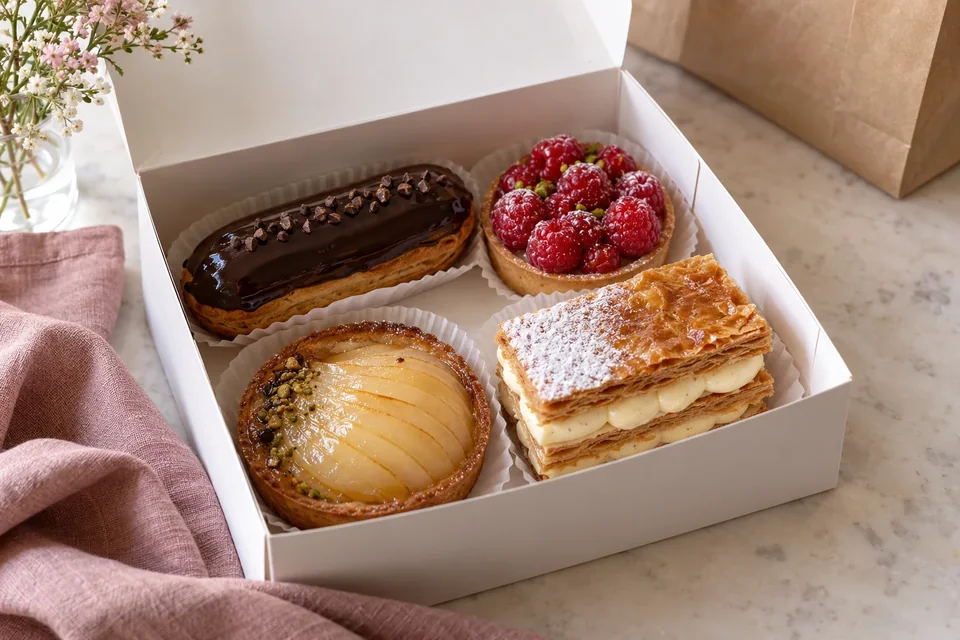
Savoury tart delivery: what the term covers
Savoury tart delivery means a caterer, baker, delivery kitchen or restaurant bakes a pastry case filled with vegetables, cheese, fish or meat and brings it to your home. Savoury tart delivery is a simple idea: the tart is baked ahead and arrives ready to eat or ready to warm through.
It differs from a quiche, where an egg and cream custard is part of the definition. A savoury tart allows far more freedom. It can be lidded like a pie or left open, and it can sit on shortcrust, sweet pastry, puff pastry or even pizza dough. The range runs from a thin tomato and mustard tart to leek, onion or endive tarte tatin.
That freedom is the great strength of tart delivery. A tart cuts into tidy slices, tastes good hot, warm or cold, and goes with many sides. It is a practical weekday dish and a quiet party dish at the same time, popular with people who like to eat well but have no wish to spend an evening rolling pastry.
Seasonal tarts: what each time of year brings
The season dictates the filling. In spring, asparagus, peas, radishes and fresh herbs make light tarts, often paired with fresh goat’s cheese or ricotta. Summer belongs to tomato, courgette, aubergine, pepper and basil, sometimes lifted with mustard or olive paste. Autumn is the time for mushrooms, squash, pumpkin, and pears with blue cheese and walnuts. In winter, leeks, endives, cabbage, caramelised onions and strong cheeses such as reblochon or munster warm the table.
Choosing savoury tart delivery by season keeps the vegetables tastier and usually fresher. A provider that renews its menu through the year is probably working with suppliers rather than relying on frozen stock, so seasonal choices are worth favouring when you order. It also gives you menu ideas: a spring asparagus tart with new potatoes, a winter leek tart with a bowl of soup, or a summer tomato tart with a simple leaf salad and a glass of something cold. Matching the tart to the weather makes the meal feel planned rather than improvised.
Pastry and fillings: vegetables, cheese and protein
Shortcrust, rich in butter, gives a firm, crisp and slightly crumbly base that suits a heavy filling. Sweet pastry brings gentleness, and puff pastry brings lightness, though it softens faster under wet vegetables.
Wet fillings such as tomato, courgette and mushroom do better when pre-cooked or salted and drained before they go in, otherwise the base turns soggy. A thin layer of mustard, semolina or breadcrumbs on the pastry acts as a barrier against moisture, a common trick in savoury baking.
Cheese changes both flavour and texture: goat’s cheese melts, feta stays firm, a mature hard cheese gratinates and blue cheese sharpens. Protein completes the dish, with bacon, ham, salmon, anchovies, hard-boiled eggs, or nuts and pine kernels in vegetarian versions.
Tart delivery sizes: individual, sharing and mini tarts
Providers offer several sizes, and it is wiser to compare them with the number of guests than with a label such as family size. A small individual tart serves as a single dish with a salad, or as a starter. A cut slice lets you vary flavours without buying a whole large tart. A whole tart, for four to eight people, suits a family lunch. A platter of mini tarts fits drinks parties and buffets.
For a full meal, count one generous slice per adult with salad and cheese, or two smaller slices if the tart is the only dish. For a buffet, allow about two small pieces per person alongside other food. For example, a table of ten with a salad and cheese board would be comfortable with a large tart cut into ten slices.
Savoury tarts delivered in one piece, and warming them up
With any tart delivery, the tart survives the journey if it is laid flat in a rigid box, wedged in place and kept level. A tilted tart loses its filling and cracks, so ask the provider about this first. Baking paper between the tart and the lid stops steam condensing on top.
To reheat, use a gentle oven and leave the tart a few minutes on the rack so the base crisps again. On a hot baking tray it recovers its pastry better than in a cold dish. A microwave works in an emergency but softens the base.
Home-delivered tarts served warm show more aroma than one served scalding. It goes happily with a green salad, a soup or a poached egg, and leftovers can be cut into squares for an impromptu nibble.
Storage, allergens and sensible precautions
Tarts containing eggs, cream, soft cheese, fish or meat must go back in the fridge as soon as they leave the table. A vegetable and cheese tart stays pleasant for a day or two refrigerated, but follow the producer’s use-by date.
The most common allergens in these recipes are gluten in the pastry, milk in butter, cheese and cream, eggs, sometimes mustard, tree nuts in pesto or walnuts, fish and celery. Say so when you order and ask for a precise ingredients list, because a vegetarian tart can still contain rennet cheese or chicken stock.
For particular diets, ask about gluten-free or plant-based pastry and about separate work surfaces. Individual nutritional advice should come from a doctor or dietitian.
How to choose a provider for delivered savoury tarts
For savoury tart delivery the useful criteria are concrete. Are the tarts different from season to season? Do the vegetables come from local growers? Is the pastry made in house with butter? Does the provider state size, weight and shelf life? A good caterer also handles special requests: a tart without pork, without lactose or egg-free, or a smaller version, and it states the baking date, storage temperature and reheating method.
Openness on these points is worth more than a flattering photo. Treat the first order as a trial, with one tart for a small meal, before you commit to a large party order. Finally, avoid three common errors: ordering a tart too big for the fridge, forgetting to balance the meal with salad or raw vegetables, and leaving the tart out for hours at a party.
Frequently asked questions
Is a savoury tart the same as a quiche?
No. A quiche relies on an egg and cream custard. A savoury tart is a wider term: a pastry case filled with vegetables, cheese, fish or meat, with or without custard.
Which savoury tart suits a vegetarian meal?
Seasonal vegetable, goat’s cheese, mushroom, squash or tomato tarts work well. Check the product sheet for bacon, gelatine and animal stock.
How can I avoid a soggy base on arrival?
Pick a provider that pre-bakes the base and drains wet vegetables. At home, put the tart back in the oven on a hot tray to restore crispness.
How many people does a whole tart feed?
A family-size tart usually feeds four to eight, depending on whether it is the main dish with salad or one dish among many on a buffet.