
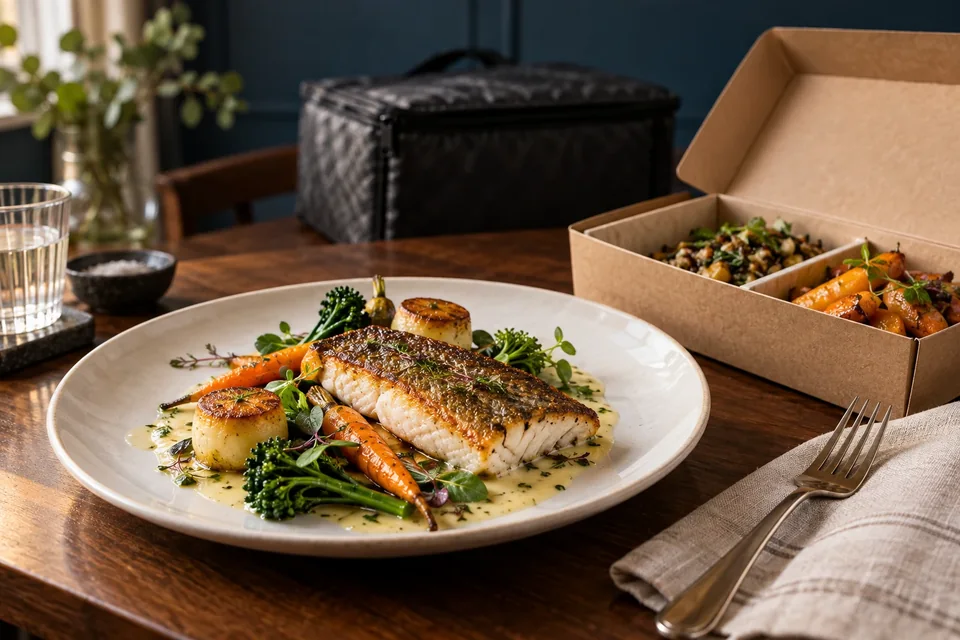
What allergen-aware meal delivery means
Allergen-aware meal delivery means ordering cooked food to be brought to your home while taking steps to keep an allergen out of the meal, whether you are allergic yourself or buying for a child, a parent or a guest. It is a way of ordering, not a certified product category. A kitchen can call a dish allergen-aware and still use shared equipment, so the label proves little without the facts behind it.
The people involved are many: restaurants, caterers, supermarkets selling chilled meals, apps that pass orders on, and couriers who simply carry the bag. Responsibility for the information sits mainly with the business that prepares the food.
Allergen-aware meals delivered from a large central kitchen differ from those cooked by a single chef in a small restaurant. A big operation may have written procedures and trained staff, while a small one may know every ingredient personally but lack separate equipment. Neither model is automatically safer, so the useful skill is asking the right questions of each.
The fourteen allergens named in UK and EU law
Food businesses in the UK and the EU must tell customers when a dish contains any of fourteen allergens: celery, cereals containing gluten, crustaceans, eggs, fish, lupin, milk, molluscs, mustard, tree nuts, peanuts, sesame, soya and sulphur dioxide or sulphites above a set level. Lupin and sesame surprise many people, because they turn up in flour blends, breads, tahini and sauces.
The list does not cover every possible allergy. Someone allergic to kiwi, coriander or buckwheat has to ask the kitchen directly, since there is no legal duty to flag those foods in the same way.
Since the rule on pre-packed-for-direct-sale foods was tightened in the UK in October 2021, a sandwich or salad made and wrapped on the premises must carry a full ingredient list with allergens emphasised. Food cooked to order and handed over in a container is not covered in the same way, which is why the conversation with the kitchen remains important.
Allergen-aware takeaway: the information you are owed
Rules differ slightly between countries, but the principle is the same. In Great Britain, businesses selling food by distance, including through an app or phone, must make allergen details available before the order is placed and again when the food is delivered, in writing or by another clear means. Ireland and the EU apply comparable requirements, and in the US the picture varies by state and by chain.
For allergen-aware meal delivery, use the written information, not the cheerful voice on the phone. If the menu page says nothing, that absence is itself a signal to ask or to choose another provider.
Allergen-aware meals delivered: the cross-contact problem
A dish with no peanut on its ingredient list can still carry traces if it was made on a surface, in oil or with a utensil that touched peanut. Fryers, woks, grills, blenders and shared serving spoons are common routes. Wording such as "may contain" is a voluntary warning about this risk, not a guarantee in either direction.
- Ask whether allergen-aware takeaway dishes are prepared separately.
- Ask which oil is used and whether it is reused for other foods.
- Ask whether the staff member plating your order changes gloves and wipes surfaces.
Meal delivery with food allergies through an app
An allergy-conscious meal service can still be let down by the platform in the middle. Platforms add a layer between you and the kitchen. Allergen filters and badges are only as accurate as the menu a restaurant uploaded, and substitutions or out-of-stock swaps can alter a dish after you have ordered. Meal delivery with food allergies is therefore safest when you confirm the dish with the restaurant itself, not only through a tag on the screen.
Write the allergy plainly in the notes field, but do not rely on it alone, since the courier and the platform may not pass it on. A short phone call to the kitchen before ordering is often the most reliable step.
Repeat customers should not assume that an order that worked last month is safe today. Restaurants switch suppliers of sauces, breads and oils, and a recipe that was nut-free in spring may now include a nut paste. Re-checking takes a minute and protects against the one change that matters.
Children, older adults and group orders
In allergen-aware meal delivery for families, the stakes rise. Children often react to a smaller amount, and older people may not recognise early symptoms or may take medicines that complicate treatment. For a school or care setting, the person ordering should have the allergy plan to hand, as set by the doctor or allergy clinic, and a named adult should check each delivered meal against it before serving.
For a party or office lunch, order the allergy meal separately, label it and serve it first, away from shared platters. Mixed buffets are where mistakes happen.
Caterers who supply schools, nurseries and care homes usually keep an allergy register and prepare named meals. If you are responsible for others, ask to see how that register is kept and how the meal is labelled on delivery, then confirm the label matches the person it is meant for.
When symptoms appear after a delivered meal
Recognise the signs of a severe reaction: swelling of the lips or face, difficulty breathing, wheeze, a sudden rash, vomiting or feeling faint. Anyone who has had meal delivery with food allergies go wrong once will know how quickly it escalates. Anyone prescribed adrenaline should use it as their medical plan says and call emergency services at once, which is 999 in the UK, 112 in the EU and 911 in the US and Canada.
Reporting matters because it can prompt a kitchen to correct a mistake before someone else is harmed. Keep the packaging, the menu page and the order confirmation. They help doctors, the restaurant and the local environmental health team understand what was eaten.
An allergen-aware takeaway checklist to repeat every time
Allergen-aware meal delivery works best when the same routine is followed each time, because kitchens change staff, suppliers and recipes more often than menus change.
- Read the written allergen information for the exact dish.
- Call the kitchen and name your allergy clearly.
- Confirm how the food is prepared and plated.
- Check the order when it arrives, including any substitutions.
- Keep your emergency medication within reach.
If anything feels uncertain, do not eat the meal.
Frequently asked questions
Do delivery apps have to show allergen information?
In Great Britain, food sold at a distance must provide allergen information before ordering and on delivery. Quality of detail varies, so confirm with the restaurant.
Does "may contain" mean a dish is safe if the allergen is not listed?
No. It is a voluntary warning about possible traces. Absence of the warning does not prove absence of the allergen, so ask the kitchen.
Which allergens must be declared in the UK?
Celery, gluten cereals, crustaceans, eggs, fish, lupin, milk, molluscs, mustard, tree nuts, peanuts, sesame, soya and sulphites.
Can a courier help with my allergy?
Couriers only carry the order. Raise your allergy with the restaurant before ordering, since the person delivering will not know what is in the bag.