
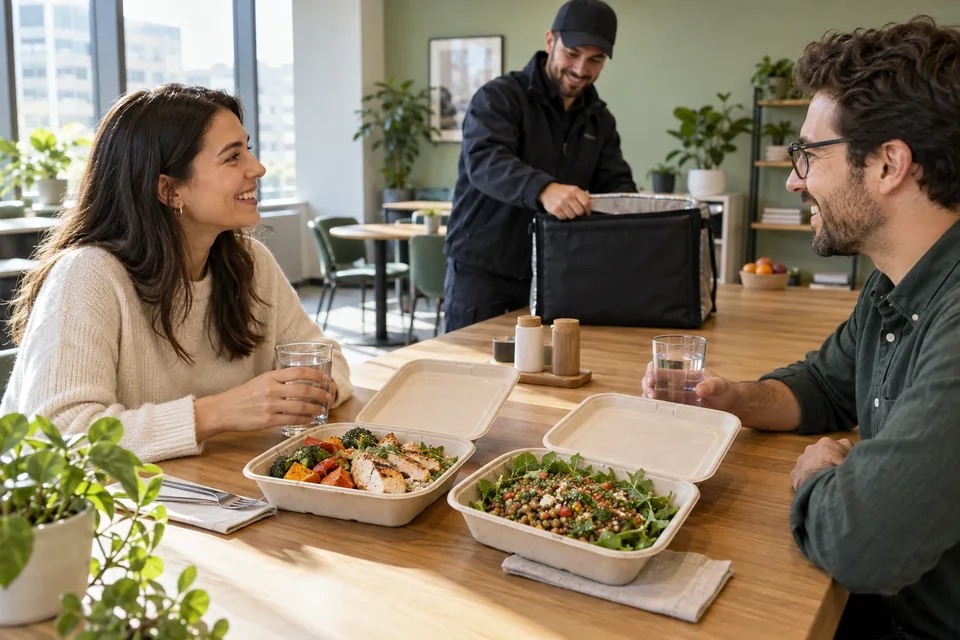
Home-delivered meals in Guadeloupe: an archipelago in two wings
Home-delivered meals in Guadeloupe are the services that bring a prepared dish to an address in the archipelago: meals on wheels for older people, lunches delivered to workplaces, and Creole dishes ordered from a restaurateur or caterer. Guadeloupe has two main islands joined by a bridge, flat limestone Grande-Terre and volcanic, forested Basse-Terre, plus Marie-Galante, Les Saintes and La Désirade. Most people and most business sit around Pointe-à-Pitre, Les Abymes, Baie-Mahault and Le Gosier, which is where deliveries are most frequent.
Beyond that core, on the Leeward Coast or in mountain communes, distances grow and choice shrinks. The first job before ordering is to confirm that the provider serves your commune.
Because the two wings are so different, home-delivered meals in Guadeloupe are really a patchwork of small local arrangements rather than one island-wide network. A driver based near Baie-Mahault does not casually cross to the far end of Basse-Terre, and a caterer in Le Gosier may stop at the edge of town.
Needs differ with the person. A resident wants regularity, a holidaymaker in a rental wants local cooking to take away, and a carer based in mainland France wants a dependable arrangement for a parent they cannot visit every week.
Meals on wheels for seniors: what one local provider offers
A home-services company based in Baie-Mahault devotes a page to meal delivery. It addresses seniors at home, with a dedicated menu, as well as individuals and businesses at their workplace. The senior formulas include salt-free meals, hearty meals, grilled fish, blended meals and grilled meat, plus a local soup, with root vegetables, starches and vegetables on the side. The monthly menus can be read online.
The company states that delivery takes place in the morning, between nine and noon, by the same driver, and that orders can be placed from one day to four weeks ahead, before noon. Payment is by card, cash or cheque. The stated service area is the south of Grande-Terre and the north of Basse-Terre, so a commune outside it will not be served. Service days differ between sections of its website; confirm them by telephone before planning a whole week.
Colombo, court-bouillon, accras and boudin as delivered lunches
Guadeloupean cooking suits eating at home. Colombo of chicken or goat, simmered with a curry-like spice blend, reheats with no loss of flavour. Fish court-bouillon, blaff, conch fricassee and the z’habitants soup full of root vegetables survive transport well provided they stay in a sealed container.
For a family, a practical routine is to pick two or three dishes that reheat well and rotate them through the week, keeping fragile items such as accras and bokit for the day of cooking. That way a delivered lunch never feels repetitive, and little goes to waste.
Salt cod accras are wonderful straight from the fryer but go soft quickly in a closed tray, so eat them within half an hour. Spicy Creole black pudding travels well. Rice, yam, sweet potato, pumpkin and green banana form the base of most plates, while a bokit, a filled fried bread, should be eaten soon after cooking.
When ordering for several people, ask for sauces on the side, keep the rice apart from saucy dishes and state how much chilli you want, because Caribbean pepper is hot.
Markets, local produce and village shops
Guadeloupe has busy markets, notably in Pointe-à-Pitre, where stalls of fruit, root vegetables, spices and fish draw residents and visitors. Island produce is emblematic: bananas, sugar cane, agricultural rum, Basse-Terre coffee and vanilla, pineapple, coconut and christophine. Fish and seafood come from the fishing harbours of the coast.
For cooking at home, some neighbourhood shops accept telephone orders and prepare a basket to collect. Village grocers often act as a drop for the day’s cooked dishes, sold until they run out, so ask neighbours about the addresses in your area.
For home-delivered meals in Guadeloupe, these short supply chains have an advantage: vegetables and fish are bought fresh, and the cook will happily adjust seasoning, salt and portions for an older person who eats little.
Heat, rain and traffic: what matters for a delivered lunch
The climate calls for caution. A dish left for hours in a car or on a doorstep turns quickly, so refrigerate delivered food on arrival and reheat it thoroughly. The hurricane season, from June to November, brings heavy rain and occasional alerts that halt deliveries; keep a few tins and some water in reserve.
Traffic around Pointe-à-Pitre, Jarry and the Gosier road is heavy at peak hours, morning and late afternoon, and a short trip can take long. A driver who sets off early in the morning, as with scheduled meals on wheels, avoids the queues. On neighbouring islands such as Marie-Galante, delivery depends on the local caterer and on the ferry.
Paying for meals on wheels: allowances and first steps
In Guadeloupe, as elsewhere in France, funding a meals-on-wheels service depends on the person’s situation. The personalised autonomy allowance is run by the département; commune social centres (CCAS) advise on local aid; pension funds and some mutual insurers also offer help. Personal-services providers may give entitlement to a tax benefit, depending on the case: ask the tax office and the provider.
The process starts with a call to the commune’s CCAS or the département’s social action department, which assesses the need and points to approved providers. Keep proof of payment and request a written quote or contract stating the delivery days, the menu type and the cancellation terms.
It also helps to ask early whether the provider accepts changes at short notice, because a hospital appointment or a family visit can alter the week. A good provider will say plainly how many days’ warning it needs, and whether a skipped meal is charged. Meals on wheels works best when everyone involved, from the cook to the neighbour, knows the schedule.
For a parent followed from a distance, a local contact such as a neighbour, a nurse or a home helper who receives the meals and raises the alarm is worth more than a fully automatic order.
Diets, allergens and the right questions to ask
Food delivery of this kind is only useful if the meal suits the person who eats it, so talk about tastes and habits as well as medical needs. Many older islanders prefer the dishes they grew up with, in smaller portions and with less salt.
Menus can be adapted: salt-free, blended, pork-free or gluten-free, depending on the provider. Ask precise questions. Is the dish prepared in a kitchen that handles gluten, shellfish or peanuts? How much salt is used? Do the sauces contain hot pepper? A diet for diabetes or kidney failure needs the opinion of a doctor or dietitian.
- Who delivers, and at what time?
- What happens if the person is out?
- Does the driver hand the meal over in person and report problems to the family?
Frequently asked questions
Which communes does a meal service cover?
It depends on the provider. A company based in Baie-Mahault states that it serves the south of Grande-Terre and the north of Basse-Terre; always check that your commune is included.
How far ahead should I order?
The provider mentioned accepts orders from one day to four weeks ahead, before noon. Lead times differ between caterers and restaurants.
Which Creole dishes survive delivery best?
Colombo, court-bouillon, blaff, z’habitants soup and Creole black pudding travel well. Accras are best eaten soon after cooking.
How can meals on wheels be paid for?
The département’s autonomy allowance, the commune CCAS, pension funds and some mutual insurers may help depending on circumstances. Contact the CCAS for an assessment.