
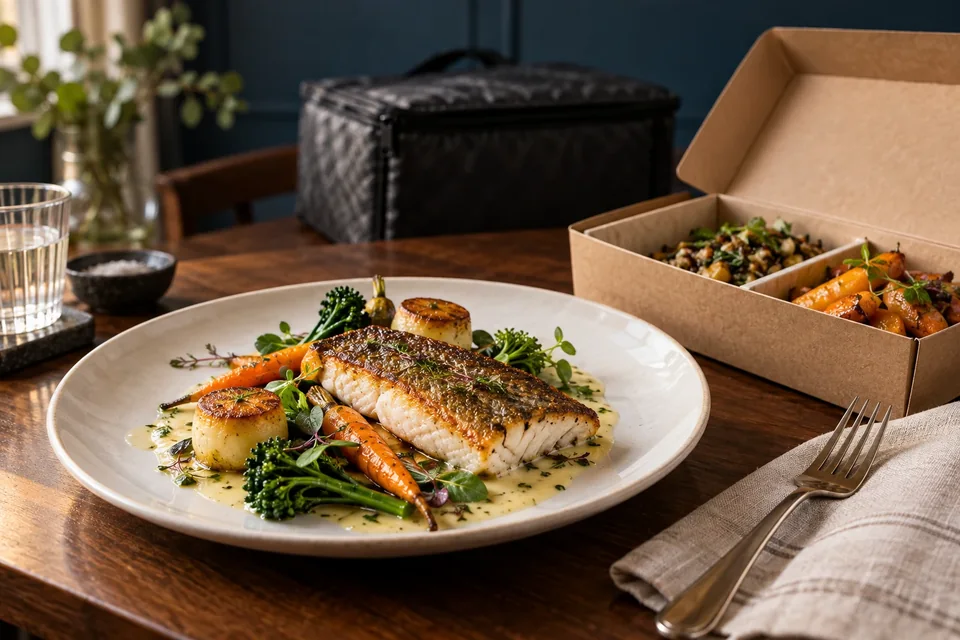
What home meal delivery in Nouméa covers
Home meal delivery in Nouméa means every way of getting a ready-to-eat meal without standing at the stove: a lunch tin brought to the office or the house, a restaurant dish ordered for the evening, a menu prepared for an older person, or a care assistant who cooks on the spot. The phrase does not point to a single operator. It describes a landscape of private, voluntary and municipal services that share the demand.
The capital of New Caledonia stretches from the city centre to Ducos, Rivière-Salée and Tina, with the Nouville peninsula set apart. That long shape explains a lot: distances are measured in traffic jams rather than kilometres, the lunch break is short, and nobody enjoys getting the car out just to eat.
Newcomers often assume that home meal delivery in Nouméa works like a city app, with a button and a rider in ten minutes. In reality much of it runs on weekly booking, phone calls and regular customers, and that rhythm is part of its charm and its limits. Office workers, retirees, families with a busy week and people recovering from an operation all use it, each for different reasons.
The information here is general; it does not stand in for a restaurant, a courier or a health professional.
The gamelle: a Caledonian institution of meal service
If one word sums up meal service in Nouméa, it is the gamelle. This typically Caledonian arrangement goes back to before the war and spread in the 1950s, when meals were taken to workers at the nickel mines. A strong habit remains: full meals with starter, main and dessert, delivered to the workplace or the home.
The principle is simple. Menus are set by the week, usually with several choices, and the customer books days in advance. The cooking is closer to a family table than to a reception caterer. Many people see it as an economical way to eat well compared with cooking every day.
A typical week might offer three or four mains, a soup or salad to start and a simple sweet to finish. Customers who eat the gamelle every day tend to book a block of days and swap when the menu does not appeal. Ask whether a smaller portion is available, since a full tin can be generous for an older person with a small appetite, and whether meals can be delivered to a neighbour or a building reception if nobody is home.
The model has a downside: hygiene rules call for plastic trays, and local recycling of them raises questions. If it matters to you, ask the provider which containers it uses and whether it takes them back.
Caledonian dishes you can have delivered
The cooking of "le Caillou" mixes Kanak, French, Polynesian, Vietnamese, Indonesian and Chinese influences. On a delivered menu you will often find raw fish in coconut milk, prawns, pork or chicken in sauce, rice in all its forms, and venison, which is common on the island.
Bougna is the emblematic dish: yam, taro, sweet potato and meat or fish cooked in banana leaves with coconut milk. A festive dish, it is traditionally prepared in an earth oven. It is ordered more for a shared meal than for a daily lunch, and it needs advance notice.
Home meal delivery in Nouméa also reflects the island’s multicultural kitchen, so a weekly menu may move from a Vietnamese-style noodle dish to a French roast, then a Pacific fish dish. That variety is one of the best reasons to prefer a rotating menu to a single fixed dish.
Fresh produce often comes from the Port market near the marina, where you find fish, tropical fruit and root vegetables. A provider who works with growers from Grande Terre usually says so proudly, so do ask.
Districts and zones: finding out whether you will be served
Not every address is served in the same way. The city centre, Vallée-du-Tir, Montravel, Anse Vata, Baie des Citrons, Magenta, Ouémo and Faubourg Blanchot have the densest restaurant supply. Further north, Ducos, Rivière-Salée and Tina have catchment zones of their own, often tied to business areas and companies.
Beyond Nouméa, Greater Nouméa includes Dumbéa, Païta and Le Mont-Dore. A rider based downtown does not always cross those commune boundaries at rush hour. Before choosing, give your exact address and ask for the real delivery window.
- Ask for a fixed day or time slot.
- Give a landmark if your street is hard to find.
- Plan a way to keep the meal cool if you are out.
Tropical climate, cyclones and the cold chain
Nouméa has a tropical climate tempered by trade winds, with a hot, humid season running roughly from November to April. That is also the time of tropical depressions and cyclones. During an alert shops close, roads may be cut and deliveries suspended, so always keep a few non-perishable meals in hand.
Heat demands discipline over temperature. A delivered meal belongs in the fridge without delay, above all if it contains fish, eggs or shellfish. Do not leave a tray in the sun on a wall while waiting to get home.
To reheat, prefer an oven or microwave and eat promptly. Avoid reheating the same dish twice, and throw away anything left several hours at room temperature.
Older residents: home help and the city’s social centre
In Nouméa, meals for an older person come first through home help. The city’s seniors guide says that private firms offer social care assistants who prepare meals and do the shopping. These services are paid for, but partial support can be considered case by case, depending on resources.
The file is built with the New Caledonia gerontology unit (GIP HDBV), which assesses the person’s situation in a personalised support plan. Where money is tight, the city’s social action centre (CCAS) can grant aid, notably for domestic help.
The guide does not clearly describe a municipal meal-delivery service. To organise home meals for a relative, contact the CCAS or the gerontology unit, who know the current offer.
Choosing a meal service that really suits you
A good choice rests on a few concrete criteria. Ask how the week’s menus are composed, how long you have to change an order, and whether a particular diet can be respected: pork-free, gluten-free, soft or minced food for someone who struggles to chew.
Think too about who actually receives the meal. A tin that arrives at noon for someone who wakes late may sit in the heat; a quick text to the driver, or a cool box by the door, solves most problems. Any meal service worth using will accept a few simple instructions of this kind.
Allergens must be stated clearly. Caledonian cooking commonly uses shellfish, fish, coconut milk and peanuts, so an allergy means asking the question at every order rather than accepting a general answer.
- Check whether the trays are microwave-safe.
- Ask how the cold chain is kept in strong heat.
- Verify cancellation terms in case of a cyclone alert.
Frequently asked questions
What is the gamelle in Nouméa?
It is a service of complete meals, with starter, main course and dessert, delivered to work or home. Menus are fixed weekly and customers book ahead. The tradition dates from before the war and the nickel workers.
Is there a municipal meals-on-wheels service for older people in Nouméa?
The city’s seniors guide mainly describes home help by care assistants and CCAS aid. For a specific meal round, ask the CCAS or the gerontology unit directly.
Can meals be delivered to Dumbéa or Le Mont-Dore from Nouméa?
It depends on the provider and the hour. Give your exact address before ordering and have the time slot confirmed, as rush-hour journeys are long.
What should I do with meals during a cyclone alert?
Deliveries may be suspended. Keep some non-perishable food and warn the provider if you have a scheduled order.