
Local charity meal delivery: what it covers
Local charity meal delivery means meals that voluntary organisations and neighbourhood groups give, share or supply at very low cost to people in need, sometimes carrying the plate to the doorstep. The forms differ: a hot dinner served in a hall, a bag of groceries to cook at home, a street lunch, a festive meal, or a dish handed over to someone who can no longer go out.
Two needs overlap here without being identical. One is financial: some people cannot afford enough food. The other is social or physical: others can pay, but they are isolated, elderly or ill, and the delivered meal is above all a link with the outside world.
Charities answer one need or the other, and some answer both. Knowing which one applies saves a lot of pointless calls and helps you knock on the right door first time.
Food aid charities and local charity meal delivery: the main kinds of help
Food aid is the first family. The French charity Les Restos du Cœur is a good illustration: it runs an accompanied distribution in which people choose products to take home and cook, within the scale set for the year. It also offers free hot meals eaten on site, in day centres, emergency shelters or on street rounds, with no income test for those meals.
Registration for the food distribution is renewed each year at a centre and requires proof of low income. The welcome is also a doorway to other help with housing, work, health and rights, and cooking workshops are sometimes held.
Other bodies, such as social grocery shops, food banks, the Red Cross and similar groups, work in comparable ways with their own criteria. English-speaking readers will recognise the pattern from food banks and community pantries. Hours and conditions change from one branch to another, so the surest step is to contact the nearest one.
Volunteer meals on wheels: what to expect
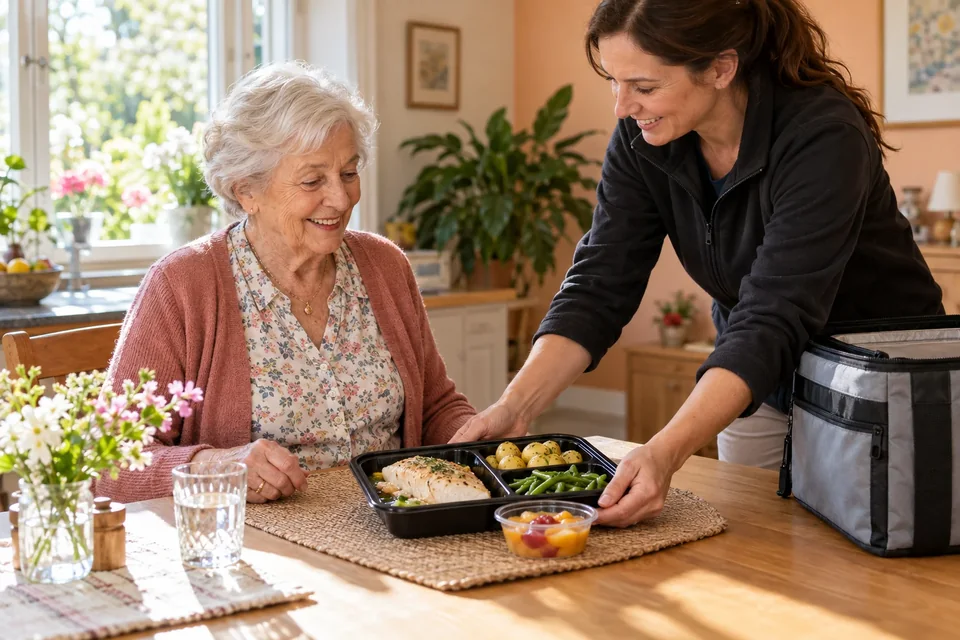
Volunteer meals on wheels exist in some areas: unpaid helpers or staff of a charity deliver hot or chilled meals to older, sick or disabled people. They are sometimes organised with the local authority, a social centre or a care home that cooks the dishes.
Coverage is patchy. In one town a municipal service exists, while a neighbouring one offers nothing similar and only a private firm delivers. Asking the town hall, the social centre or the local advice office is the quickest way to find out what is there.
The questions for a charity running a round are always the same: delivery days and time slots, whether the menu can be chosen or adapted, how diets are respected, how dishes are kept, how payment works and how the service can be stopped. A volunteer is not a health professional, so the service cannot replace medical follow-up.
Tracing local charity meal delivery and community meals nearby
Several doors lead to local charity meal delivery and the charities active in your area. The town hall or its social centre usually keeps a list of local welfare actors. District social workers, doctors, pharmacies and places of worship often know the neighbourhood initiatives, while community centres post their shared meals and workshops.
A phone call is frequently more effective than an online search because opening hours change. Ask who is the right contact, which papers to bring, whether registration is needed and how often help is granted.
Local charity meal delivery works differently in the countryside: in a rural commune, a volunteer’s round may cover several hamlets. Waiting times are then longer, and winter weather can disturb the visit.
Accepting help: sensible habits
Asking for food help is often hard. Remember that these organisations welcome people without judgement, and turning to them is nothing to be ashamed of: the reception is designed to listen and signpost.
- Bring identity papers and, if registration demands it, proof of income.
- State allergies, medical or religious diets and foods that cannot be eaten from the outset.
- Ask how to store fresh products received and whether they must be eaten quickly.
- Warn the charity of an absence, a move or a hospital stay so a place is not blocked.
- Enquire about other possible help, since the welcome desk is often a door to other schemes.
A relative may make the request for an older person, but that person’s agreement remains essential, both for registration and for delivery to their home.
Limits of local charity meal delivery and the alternatives
Food aid charities depend on volunteers, donations and collected goods. Their capacity is not unlimited, and hours and volumes can vary with the season. They cannot always adapt a meal to a strict diet such as salt-free or gluten-free, and cross-contamination is not always controllable.
In that case other solutions fill the gap: a specialist meal provider, a grant from the county or municipality to cover part of the cost, a neighbourhood caterer or groceries delivered to the door. Comparing several answers is better than depending on a single one.
For a lasting need, such as a loss of independence, an assessment by social services is preferable. It allows charity meals and more structured help to be combined, one not excluding the other.
Frequently asked questions
Who can benefit from community meals?
It depends on the charity. Some help, such as an accompanied food distribution, is for people with insufficient resources. Others, such as hot meals on site or neighbourhood lunches, set no income condition.
How do I register for a food distribution?
At a centre of the organisation, with proof of identity and of income. With Les Restos du Cœur, registration is renewed every year.
Can a charity deliver meals to my home?
Local charity meal delivery exists in some places, often together with a town or a social centre, but it is not universal. Ask the town hall or the local organisation.
How can I reduce an older relative’s isolation?
Charities arrange visits, tea afternoons and neighbourhood meals. An occasional shared meal is often more helpful than a tray delivered by itself.
Can I get a special diet?
Not always. Charities do not systematically adapt meals, so a strict medical diet is better served by a specialist provider.