
Dessert delivery: what the service is and who uses it
Dessert delivery means that a patisserie, bakery, restaurant, ice cream parlour or online cake shop brings ready-to-serve sweet items to your home: birthday cakes, mousse cakes, fruit tarts, eclairs, macarons, brownies, cheesecakes or tubs of ice cream. It is ordered for a family lunch, a children’s tea party, a gift, or simply to finish a dinner without spending the afternoon baking.
Three kinds of customer use dessert delivery most. Hosts who want something impressive on the table without an afternoon in the kitchen. Older or less mobile people for whom a trip to the bakery is a chore. And relatives living far away who want to send a cake to someone’s door for a birthday or an anniversary.
A sweet course is the most delicate part of any delivered meal. It has to arrive whole, at the right temperature, with the cream still standing and the ice cream still frozen, and that is why the choice of dessert matters as much as the choice of shop.
Dessert delivery: cakes, tarts, pastries and ice cream that travel best
For dessert delivery the safest bets have a firm structure. Baked fruit tarts, loaf cakes, financiers, madeleines, brownies, flapjacks, chilled cheesecakes and macarons in a rigid box all cope with a few bumps and a sensible wait.
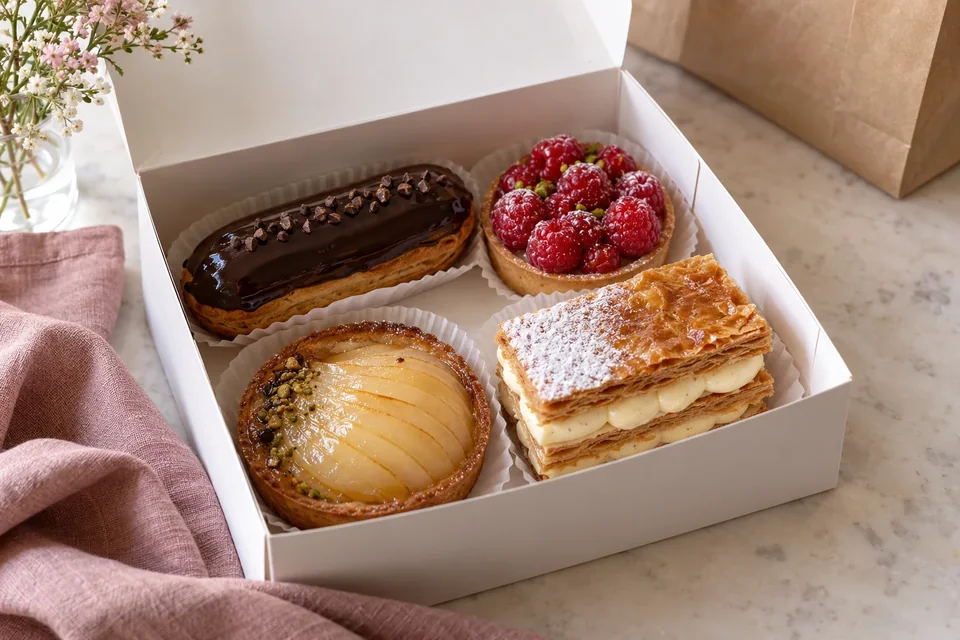
Mousse cakes and anything built on cream need refrigerated transport, kept flat in a sturdy box. Eclairs, profiteroles and millefeuille are more fragile: the glaze, the whipped cream and the puff pastry lose their shape quickly. Meringues dislike damp air, and ice cream needs an insulated bag or cool box plus a short trip.
- Baked tarts, dry cakes and biscuits: easy journey, keep for a few days.
- Mousse cakes, cheesecakes and trifles: cold transport, always flat.
- Choux pastry, eclairs, millefeuille: best for a very fast, local run.
- Ice cream and sorbet: insulated packaging and someone at home to take it in.
How a well-known patisserie describes its delivery options
As an example, the Parisian house Lenotre sets out several routes on its delivery page: collection in a shop, a courier within Paris and the inner suburbs, shipping of fresh products across France by a specialist carrier, and dry products sent to a collection point. For home delivery in the Paris area the products travel in refrigerated vehicles, in two-hour slots, on the day after the order.
That setup shows what a good dessert delivery service should offer: a precise time window, cold transport and clear rules that depend on the type of product. A neighbourhood baker will more often offer collection or a short local run in their own van, with fewer formalities but also less certainty over timing.
Whoever you choose, read the delivery terms before paying. Look for the area covered, delivery days and hours, the minimum notice, any charge, and whether you can still change the address after ordering.
Ordering a birthday cake for delivery: cake delivery in practice
A cake is best ordered several days ahead, especially a personalised one with a message, a theme, a particular decoration or a set number of portions. Allow roughly one slice per guest, with a small margin if you plan seconds.
Be precise about the day and time compared with the party. Too early and the cake sits in your fridge taking up space; too late and the whole celebration waits. Two or three hours before the event is a comfortable window, because it leaves time to take the cake out and let it come up to a pleasant eating temperature.
Candles, a cake knife, plates and decorations are not always included. Ask what is supplied so that the discovery is not made at the moment everyone is gathered to sing.
Keeping and serving delivered desserts safely
When the box arrives, open it, check that the dessert is intact and put it in the fridge at once if it contains cream, soft cheese, eggs or whipped topping. Ice cream goes straight into the freezer unless it is being served immediately.
Take mousse cakes and cream desserts out a few minutes before serving so the flavours open up, but do not leave them for hours in a warm room. Most patisserie is at its best the same day or the next, unless the maker says otherwise.
Follow the use-by date and the storage instruction printed on the packaging. A cake that has been cut should go back in a closed container in the fridge, and it will not keep indefinitely.
Allergens, special diets and alcohol in sweet treats
In dessert delivery, allergies are a high-risk area. Gluten, milk, eggs, tree nuts, peanuts and soya hide in a surprising number of recipes. A professional seller should be able to give an allergen list for each product; ask for it before ordering and get it in writing if a guest is affected.
Gluten-free, dairy-free or plant-based cakes exist, but cross-contamination is still possible in a workshop that also handles wheat flour. A specialist bakery generally offers more reassurance than a general one.
Rum babas, tiramisu and soaked cakes may contain alcohol. Children, pregnant guests and people who avoid alcohol should be told, and the seller can usually say what is in the recipe.
Pastry delivery from around the world: baklava, makroud and more
Pastry delivery opens the door to sweets that few people make at home: baklava, makroud, gazelle horns, Turkish delight, mochi, churros, canneles, tiramisu or tarte tropezienne. Their keeping qualities differ widely. Honey and almond pastries last well; custards and mousses do not.
When ordering a foreign or regional speciality, ask what is in it, how recently it was made and how it is best served, warm, chilled or at room temperature. A good craftsperson will be happy to explain.
A mixed box with a few pieces of each kind lets everyone taste without overdoing it, and it suits tables where preferences differ.
Mistakes that spoil delivered desserts
Most problems with dessert delivery come down to three mistakes. The first is choosing the most fragile dessert for the longest journey. The second is ordering at the last minute, when the kitchen has no time to prepare it. The third is not being in to receive it.
- Ordering ice cream with no room in the freezer.
- Leaving the box in the sun on the doorstep or in a car.
- Tilting or stacking boxes during the journey.
- Skipping the check of the dessert while the courier is still there.
If something goes wrong on arrival, photograph the product and contact the seller quickly. The clearer the complaint, the better its chances.
Frequently asked questions
Which desserts cope best with delivery?
Baked tarts, loaf cakes, brownies, cookies and macarons in a rigid box travel well. Mousse cakes need cold transport, while eclairs, choux and ice cream call for a quick, careful journey.
How far ahead should I order a cake?
For a personalised cake allow several days. For a standard item some shops deliver the next day. The exact lead times are set out in each bakery’s terms.
How should I store a dessert before the meal?
Put cream desserts in the fridge as soon as they arrive and ice cream in the freezer, then take them out a few minutes before serving. Respect the use-by date and the packaging instructions.
Can I get a dessert free of a particular allergen?
Some sellers offer gluten-free, dairy-free or egg-free versions. Ask for a written allergen list and ask about cross-contamination before you order.