
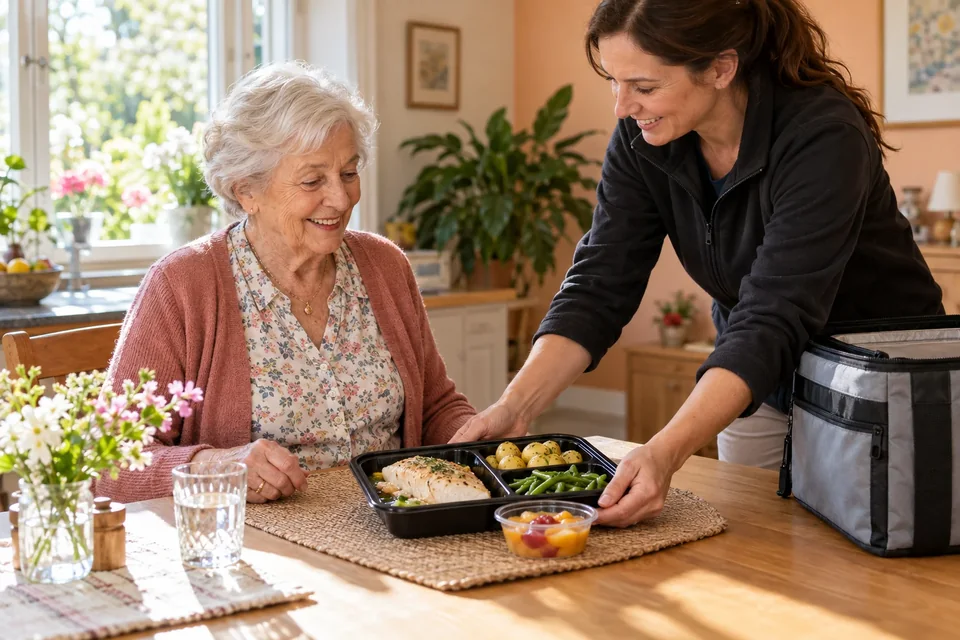
APA and meal delivery: what the allowance can cover
APA and meal delivery are linked through the care plan: the personalised autonomy allowance (APA, allocation personnalisée d’autonomie) is a French benefit paid by the département to older people who are losing independence, and meals brought to the home can be one of the things it funds. They are not included automatically. What goes into the plan depends on an assessment of the person’s situation.
According to the official description, the care plan may include paid home help, meal deliveries or transport, technical aids, home adaptations and temporary respite stays. Home-delivered meals therefore appear as one option among several, chosen when preparing food has become difficult.
The allowance pays all or part of the plan, and the person keeps a share to pay. Meals delivered at home are therefore not free by default, and the amount depends on income.
Who can receive the personalised autonomy allowance
The rules for home-based APA are set nationally, while the département manages the file. According to the French public service website, the person must:
- be at least 60 years old;
- be rated in groups GIR 1 to 4 on the national scale of loss of independence;
- live in France on a stable, regular basis, in their own home, with a relative, with a host family or in an independent-living residence;
- if a foreign national, hold a valid residence permit.
APA cannot be combined with certain other benefits, including the simple allowance of social assistance, help from a pension fund, the disability compensation benefit or the third-person supplement. Each applicant’s case therefore needs to be examined with the département.
GIR rating and the home assessment visit
Independence is measured with the AGGIR grid, which sorts people from GIR 1, the greatest loss of autonomy, to GIR 6, the lightest. Only GIR 1 to 4 give a right to the allowance. Someone rated GIR 5 or 6 can instead ask their pension fund for help, an avenue covered further below.
The assessment takes place at home and is carried out by a member of the département’s medical and social team. The visitor observes everyday actions such as getting up, washing, dressing and moving about, and also how the person prepares and eats meals. Where there is a family carer, that person’s needs are assessed too.
To make the visit worthwhile, prepare for it. Write down the real difficulties with cooking, shopping or standing for long, and ask a relative to be present. Saying clearly that meals are a problem helps ensure that the point reaches the plan.
Where meal delivery fits in the care plan
For people rated GIR 1 to 4, the professional proposes a care plan after the visit. The person has ten days to accept it or ask for changes, according to the public service site. The département then decides, normally within two months of receiving the complete file.
APA and meal delivery only go together when there is a genuine need: meal delivery is never forced on anyone; it must match a need and a wish. Before accepting the plan, check the following:
- the number of meals per week and how they are spread;
- the chosen supplier, or whether you may pick your own;
- whether the menus suit the person’s diet;
- the share left to pay for the plan as a whole.
If the proposal does not fit, say so, for instance because the supplier is not the one the person wants. The ten-day window exists for exactly that.
How much you pay yourself
APA covers the used part of the care plan, minus a contribution from the beneficiary. That contribution depends on income and on the size of the plan. The public service site explains that it is zero for a single person with modest resources, then rises gradually with income until it reaches 90% of the plan at the highest income levels. For a couple, household income is divided by 1.7 before the same scale applies.
The resources counted include declared income, certain financial investments and property other than the main home. Some benefits are left out of the calculation.
Every case ends up differently. Do not count on a precise figure until the département’s official notification arrives: the decision letter states what is covered and what remains to be paid.
Making the request: papers and steps
For an application covering APA and meal delivery, the file goes to the département of residence, online or on paper depending on the area, using the official form numbered cerfa 16301. It generally includes proof of identity, the latest tax assessment, bank details and sometimes the property tax notice.
The département acknowledges the request within ten days and asks for any missing papers. In urgent medical or social situations, a temporary flat-rate APA may be granted. After the decision, anyone who directly employs a home helper must declare that person within a month on the prescribed form.
Keep a copy of everything sent, note the dates of each exchange and file the letters from the département. If there is a delay or an unclear answer, the department’s service can be contacted to ask where the file stands.
Picking the supplier of home-delivered meals
Once the allowance is agreed to cover meals, the supplier question arises. Depending on the département, a person may choose their own company or must use approved services. Ask the medical and social team what applies locally, and whether the chosen organisation accepts funding from the département.
Then check what the service really offers: adapted menus, frequency, deadline for ordering or changing, hand-to-hand delivery or not, reheating method. The cheapest is not always the best match; a service that stays punctual, caters for diets and warns you of problems gives more.
When the person lives alone, the driver’s visit is also a regular appointment. It is worth telling the assessment team, who may see it as an extra argument.
If APA is not possible: other leads
A person rated GIR 5 or 6, or whose file is refused, still has options. They can ask about help from their pension fund, local social action through the commune or its social welfare office, the assistance cover in a mutual insurer’s or insurance policy, and the tax credit for personal services under the rules of the tax authority.
Some communes run their own meal delivery with a local price that may depend on income, and some associations offer shared meals. The most useful step is to ask one place, such as the social worker for your area or the communal social welfare centre, which knows every scheme in the territory.
Frequently asked questions
Does APA automatically pay for meal delivery?
No. Meals are funded only if they are included in the care plan drawn up after the assessment, and a contribution remains payable according to income.
Which GIR group do I need for home-based APA?
GIR 1 to 4 give a right to the allowance. People rated GIR 5 or 6 can turn to their pension fund for help.
How long does the département take to reply?
According to the public service site, the decision is normally made within two months of receiving a complete file. In urgent cases a provisional APA may be granted.
Can I choose my own meal supplier with APA?
It varies by département. Ask the medical and social team during the assessment and before accepting the care plan.