
Meal delivery in Tunis: what you can really order
Meal delivery in Tunis means cooked dishes from a restaurant, rotisserie, pastry shop, caterer or independent home cook brought to your home, hotel or office in the Tunisian capital and its suburbs. You order through an app, by phone or by a message on social media, and a courier on a motorbike or scooter, more rarely a car, hands over the bag.
Meals delivered in Tunis are mostly for one or two people at lunch and for families in the evening, and the orders follow the working day: the city centre is busiest at midday, the suburbs after office hours. At weekends, family dishes dominate, while on weekdays sandwiches, tacos and rotisserie chicken lead.
The range is wide: Tunisian sandwiches and tacos, pizzas, grills and roast chicken, but also the family dishes usually linked to Sunday lunch or festivals. The key question is to tell apart what travels well from what belongs on a table in the restaurant, and to choose a serious provider.
Tunisian recipes that cope with the journey
Couscous, with lamb, fish or vegetables, travels willingly if the semolina and the sauce are packed apart. Ojja, eggs in spicy tomato sauce often with merguez or seafood, chakchouka, mloukhia, the dark and fragrant jute-leaf stew, and the Tunisian tajine, which resembles a baked frittata of eggs, cheese and meat, are all better after a few minutes’ rest.
Lablabi, the chickpea soup poured over stale bread, should come in two containers: broth in one, bread, egg and spices in the other. Brik with an egg and fricassé, the little fried roll stuffed with tuna, olives and harissa, lose their crispness with travel time. Pick a restaurant nearby and eat them within a quarter of an hour.
To finish, makroudh made of semolina and dates, zlabia and bambalouni doughnuts all behave well in a closed box.
Food delivery in Tunis: Medina, Lac, La Marsa, which areas are covered?
Tunis spreads from the historic centre to the lakeside and the northern suburbs. The Medina, a UNESCO World Heritage site, has small stalls, but its narrow lanes and steps complicate handovers, so people often agree a meeting point at the edge of an accessible street. The modern centre around Avenue Habib Bourguiba, Lafayette, Mutuelleville, El Menzah and Le Bardo is well served.
In the north, Berges du Lac, Lac 1 and Lac 2, Carthage, Sidi Bou Saïd, La Goulette and La Marsa gather restaurants, hotels and homes; Ariana, La Manouba and Ben Arous complete the urban area. The offer thins out away from the centre and waits grow at peak hours, particularly around one o’clock and in the evening.
Tunis home delivery also depends on traffic. The roads between the centre, the lake and the northern coast fill up at rush hour and on summer weekends when people head for the beaches, so a courier that takes ten minutes at ten in the morning may need three times as long at six. Allow for it when you order for a set time.
Always give a landmark such as a pharmacy, café or school and a phone number that is picked up, since Tunisian addresses often rely on landmarks as much as on house numbers.
Apps, restaurants and how to pay
Among the platforms, Glovo covers Tunis with restaurants, groceries and express errands. Other national apps and small neighbourhood services exist and change quickly: an app can vanish or be bought out within months, as the Tunisian delivery market has shown in recent years.
For ordering lunch in Tunis, many restaurants deliver themselves by phone or through their own pages. This is often faster for a large family dish, and you speak directly to the person cooking.
A short message to the kitchen before ordering lunch in Tunis for a group, asking what is available at that hour, saves disappointment: dishes such as couscous or mloukhia are cooked in batches and may be finished before the evening.
Payment is in Tunisian dinars, in cash on delivery, by card or e-wallet depending on the service. A foreign card is not always accepted by local apps, so keep some cash. A tip is appreciated but optional.
Ramadan, Eid and Mouled: the busiest moments
Ramadan brings the busiest weeks of the year. Ftour, the breaking of the fast, often includes soup such as chorba frik, brik, mechouia salad, a main dish and pastries. Orders pile up just before sunset, waits lengthen, and it is wise to order early in the afternoon.
For Eid, pastries and festive dishes are in demand; for Mouled, the Prophet’s birthday, many pastry makers sell assida zgougou, a cream scented with Aleppo pine seeds. The dates of religious festivals move every year with the lunar calendar, the official announcement comes shortly before, and it is prudent to book early.
For a family meal, order at least two or three days ahead and state the number of guests, the containers and the time. Festive dishes are often ordered as sharing platters: ask for clear portions and enough cutlery.
Heat, sirocco and food delivery in Tunis in summer
Summers are hot, and the sirocco, the scorching wind from the south, makes storage trickier. Dishes made with egg, mayonnaise, raw fish, minced meat or dairy must not wait outside the fridge. If the meal arrives in the midday heat, eat it quickly and chill what is left at once.
Meal delivery in Tunis in the hottest months is easier with a short trip. Choose a provider close to your address, ask for the bag to be sealed and open it as soon as it arrives.
To reheat without drying out, add a little water or stock to the couscous and the sauce separately; harissa goes in at the end. Leftover couscous keeps only a short time in the fridge, so it is better to order the right portion.
Anyone with an allergy to gluten, egg, peanut, tree nuts or fish should say so before ordering. Pastries very often contain nuts and wheat semolina.
Meals on wheels and older people in Tunisia
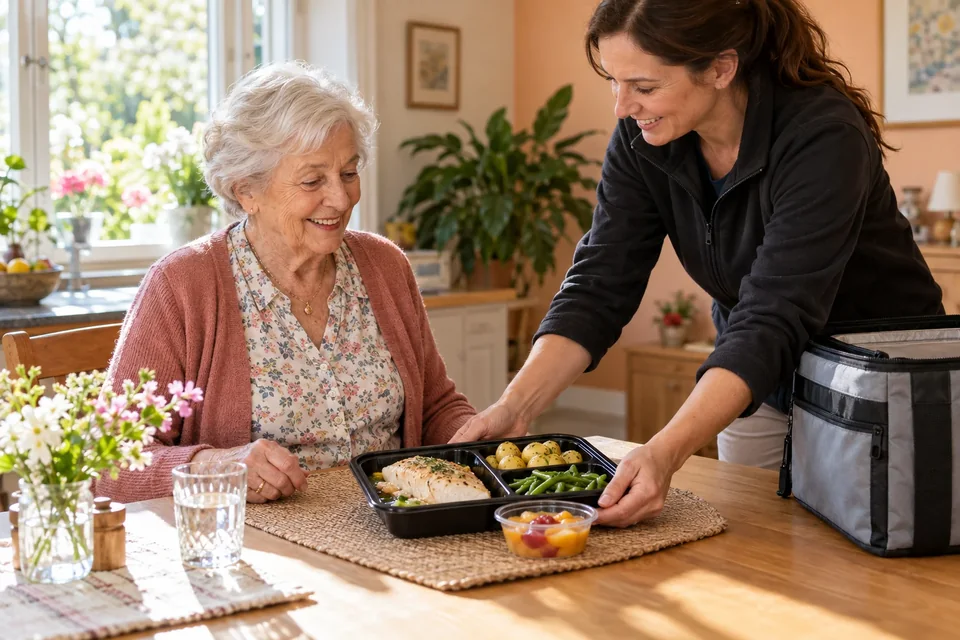
A national service of meals on wheels comparable with those of the UK or Europe is not common in Tunisia: support for older people rests mostly on family, neighbours and charities. Some associations, restaurants and home cooks do agree to deliver a balanced meal each day or each week to someone living alone, and the arrangement is made privately.
State the texture wanted, the level of salt and spice, and favour containers that are easy to open. Anyone on a diet for diabetes, high blood pressure or kidney problems should follow the doctor’s or dietitian’s advice and pass it on to the cook; no provider replaces that advice.
With meal delivery in Tunis for an older person who lives alone, it helps to agree on a call at delivery time: the courier’s visit then doubles as a small daily contact.
Frequently asked questions
Can I have a full couscous delivered in Tunis?
Yes, many restaurants and home cooks offer it, mostly on Fridays. Ask for semolina, sauce, meat and vegetables in separate containers, and order the day before for many guests.
Are delivered dishes suitable for Ramadan?
Yes, many restaurants have ftour menus. Order early in the afternoon and give the exact sunset time so that the food arrives on time and still warm.
Which payment method should I plan for?
Tunisian dinars in cash remain the simplest; card or e-wallet depends on the service. Keep small change for the courier.
Does meal delivery in Tunis cover the suburbs as well?
Yes for most districts of Greater Tunis, with zones and waits that vary. Check the delivery zone before ordering and give a precise landmark.