
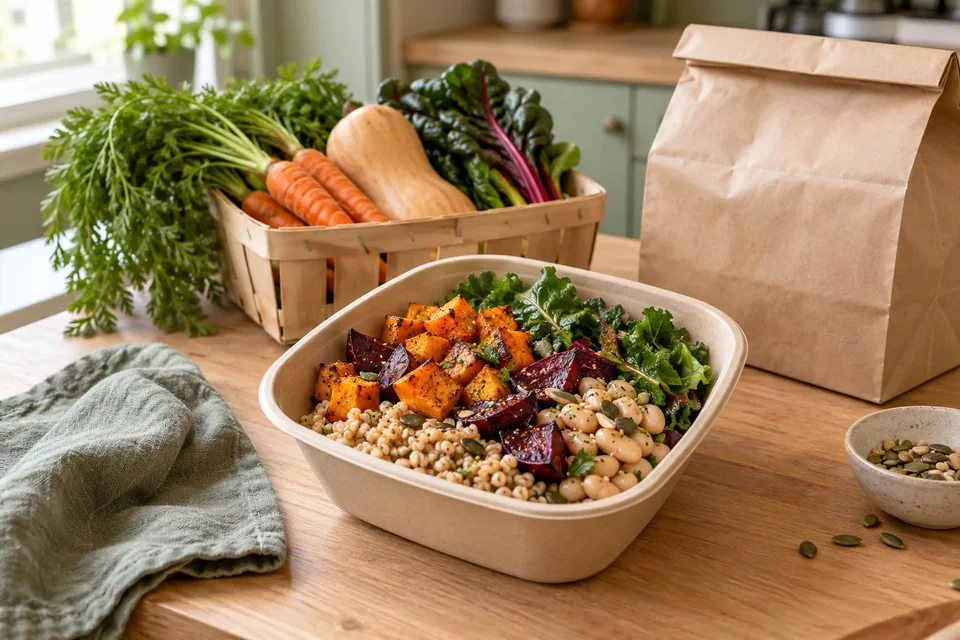
Low-salt meal delivery: what does a delivered dish promise?
Low-salt meal delivery means dishes prepared without added sodium chloride, during cooking or at seasoning, and brought to the customer’s home. The phrase covers several levels in practice: some suppliers speak of low-salt menus, others of "no added salt" dishes, others of low-sodium meals. The terms are not interchangeable, because food contains sodium naturally even without a salt cellar.
A menu sold through low-salt meal delivery can therefore be "no added salt" and still carry sodium through bread, cheese, cured meat, stock or tinned vegetables. Conversely, a menu labelled low in salt may contain a small, carefully measured amount. The first reflex is to read the nutrition panel and the ingredient list, not just the name of the dish.
These meals are often requested by people on a prescribed diet, for high blood pressure, heart failure or kidney disease, but also by relatives who simply want to cut back. The exact level of restriction is an individual medical decision.
Salt and sodium: two words, one issue
On labels, the amount of salt is calculated from sodium: salt equals sodium multiplied by about 2.5. When a product shows 0.4 g of sodium, it holds close to 1 g of salt. This conversion explains much confusion, since some products still list sodium alone.
The World Health Organization advises adults not to exceed 5 g of salt a day. Real intake is often higher, and much of it comes from processed foods rather than the shaker. That matters when comparing low-salt meal delivery offers: an industrial dish or a mass-produced tray can hold, on its own, a large share of the daily limit.
If your doctor has set a precise target, apply it to the "salt" figure of each tray rather than to advertising wording. The sum is simple: add up the day’s meals, bread and snacks.
What label claims on salt guarantee
Salt claims are governed by regulations on nutrition claims. "Low in salt" corresponds to a maximum of 0.3 g of salt per 100 g of product; "very low" is stricter still; "salt-free" or "sodium-free" allows only traces. "No added salt" refers to the absence of an addition, not to a capped content.
A handmade dish sold loose by a small business is not always bound by the same labelling duties as a pre-packed one, so you can ask directly for the composition sheet, with the salt per portion.
Beware of shortcuts. "Light" does not mean lightly salted, and "organic" or "homemade" imply no limit on salt. For reduced-salt ready meals, a good supplier gives you a figure, a reference portion and, ideally, the method of calculation.
Flavour in low-salt meals delivered: herbs, acidity and cooking methods
Cooking with no added salt does not mean giving up taste. A skilled cook preparing no-added-salt meals uses the sharpness of lemon juice or vinegar, fresh herbs (chives, parsley, basil, dill), garlic, onion, roasted shallot, mild spices such as paprika, cumin or turmeric, and citrus zest. Methods that concentrate aroma, such as roasting, grilling or cooking in parchment, also help.
Be careful with salt substitutes based on potassium chloride: they do not suit everyone, especially in kidney disease or with certain medicines. Do not introduce them without the advice of a doctor or dietitian.
Taste adapts over time: the palate gets used to less salty food within a few weeks. During the first deliveries it can help to keep lemon, herbs and olive oil to hand so you can adjust the dish yourself.
Meals on wheels, caterers or platforms: where to find low-sodium meals
Meals-on-wheels schemes for older or ill people often offer adapted menus, including reduced-salt options. This is usually something to request at registration, sometimes backed by a medical note. Caterers and private chefs can prepare personalised cooking, with an ingredient list you approve beforehand.
On delivery platforms, a "light" or "healthy" section guarantees nothing about salt: read the descriptions and write to the restaurant if in doubt. A few makers of chilled or frozen dishes state the salt content of each recipe plainly, and that is the criterion to look for.
In Ireland, Belgium, Switzerland or Canada, local home-meal schemes (meals on wheels, repas sur roues, popote roulante) have their own rules; ask the service run by your council or region.
Storing and reheating a low-salt meal without re-salting it
A tray of low-salt food keeps according to the use-by date on the packaging, in the cold. Once opened, eat it within the stated time. Reheating in a microwave or a bain-marie adds no sodium, though it can heighten or mask some aromas: adjust with a squeeze of lemon rather than the salt cellar.
A common risk is re-salting at the table out of habit. Put the salt cellar away and offer herbs, pepper or a salt-free spice blend. Watch the extras added afterwards, such as grated cheese, soy sauce or bread, which can cancel the work done in the kitchen.
For an older person who is losing taste or appetite, a low-salt meal can seem dull; in that case talk to the supplier about texture and flavour adjustments rather than abandoning the diet.
Questions to ask and mistakes to avoid
Before choosing a low-salt meal delivery supplier, ask:
- how much salt each dish contains, per portion;
- whether added salt is truly absent or only reduced;
- which stocks, sauces and bases are used;
- whether the menus are checked by a dietitian;
- how requests for a stricter diet are handled.
Common mistakes include choosing a "no salt" dish served with an industrial sauce, forgetting bread and cheese in the count, and thinking that a "natural" product must be low in sodium. Never alter a prescribed diet alone: a sodium level that is too low can also be a problem, depending on treatment.
Your doctor and your dietitian are the only people who can set your personal target.
Frequently asked questions
What is the difference between no added salt and low in salt?
No added salt means none was put into the recipe, though the ingredients may contain some. Low in salt refers to a measured content, capped per portion or per 100 g.
Is a low-salt meal always bland?
Not necessarily. Herbs, mild spices, zest and grilled cooking give depth. Most people adapt to less salty food within a few weeks.
Can I use a salt substitute with these meals?
Only with your doctor’s approval. Potassium-based substitutes do not suit kidney disease or some treatments.
How can I check the salt in a delivered dish?
Look at the nutrition panel, at the salt line, and relate it to the portion. If it is missing, ask the supplier for the composition sheet.