
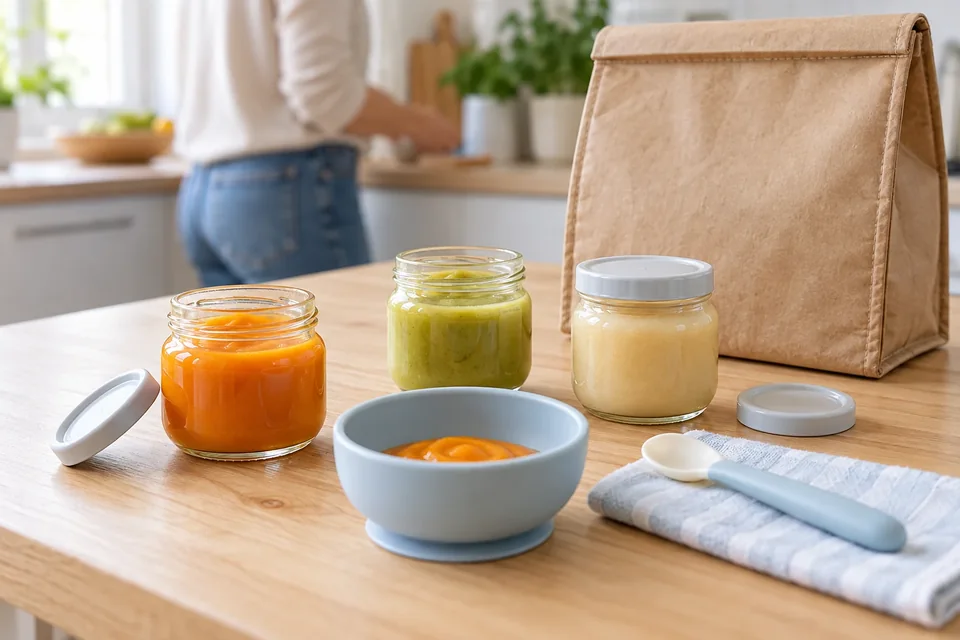
Baby meal delivery: what it covers and why parents use it
Baby meal delivery means that purees, small prepared dishes, pouches or jars made specially for infants and toddlers are sold by a manufacturer, an online shop or a retailer and then brought to the parents’ home. It covers the weaning period, when a child gradually discovers foods other than milk, up to the first meals shared at the family table.
Baby food delivery answers very practical situations: a parental leave that leaves little spare time, twins, a single parent, a return to work, a tiring week or a house move. Jars and pouches from a baby food delivery also act as a back-up when there has been no time to cook, or when the family travels with a small child.
Commercial baby food, including meals sent by an online shop, follows strict rules on composition and labelling. It does not replace milk, nor the advice of a health visitor, paediatrician or GP.
Weaning stages and textures for baby food delivery
In the UK, health services advise starting solid food at around six months, alongside milk, and the World Health Organization recommends exclusive breastfeeding for the first six months. The right moment for a particular child is a matter for the health professional who knows them, because every baby sets its own pace.
Textures change with age. First purees are completely smooth, then come thicker mashes, then soft lumps that melt in the mouth, and finally foods that need chewing. Makers print a minimum age on the pack, and it should be respected.
- First spoonfuls: very smooth vegetables or fruit, one ingredient at a time.
- Widening out: mixtures of vegetables and starch, with puréed meat or fish.
- Lumps: bumpy then soft-lumpy textures to practise chewing.
- Family meals: adapted dishes without much salt or strong spices.
Baby meal delivery formats: jars, pouches, chilled or frozen?
Glass jars and pouches keep at room temperature until opened, which makes them practical for outings. Chilled or frozen meals, often cooked from organic ingredients, need cold storage but sometimes taste closer to home cooking.
As an example, the French brand Popote Bebe sells organic ready meals from six months in individual 180 g containers, with a use-by date on each product page and packs you can build yourself. Each brand has its own storage, delivery and reheating rules, so the details on every product page matter.
The best baby meal service depends on daily life: how often you go out, how much freezer space you have, what your child will actually eat and what you can spend. Many families mix shelf-stable jars for emergencies with chilled meals for home. Trying a small pack first shows whether the flavours, the portion size and the packaging suit your child before a bigger order goes in. It also helps to note which dishes were accepted with enthusiasm and which were pushed away, so that the next basket reflects real preferences rather than guesswork.
Baby food delivery labels: ingredients, allergens and wording
On delivered baby meals, check the ingredients list, the minimum age, any added salt or sugar, the use-by date and the instructions. Makers often remind buyers that recipes change, so it is worth rereading the label on every order.
Major allergens have to be clearly highlighted. If there is allergy in the family, the doctor will say when and how to introduce risky foods such as egg, fish, wheat or nuts. Do not try to work out the right approach from a label alone.
The word organic describes a way of farming. By itself it does not guarantee that a meal is suitable for a given age or need; only the detailed wording does.
Storing and reheating baby food delivered to your door
With baby food delivered chilled, products stay in the fridge and are eaten before the use-by date. Frozen meals are thawed in the fridge and are not frozen again. An opened jar keeps according to the maker’s note, usually in the fridge and for a very short time.
To reheat, use a bain-marie, a bottle warmer suited to the purpose or a microwave, stirring thoroughly at the end to remove hot spots. Always test the temperature on the inside of your wrist before serving. Some meals can be given lukewarm or cold if the packaging says so.
Never save leftovers from a bowl the baby has already eaten from with a spoon, because saliva helps bacteria multiply. Serve small portions and top up if needed.
Risks to know about: choking, honey, salt and drinks
Hard, round or slippery foods such as whole nuts, peanuts, whole grapes or sausage chunks are a choking hazard for young children. Cut, mash or avoid them depending on age, and always stay with a child who is eating, seated in a suitable chair.
Honey is not advised before the age of one because of the risk of infant botulism. Added salt and sugar should be kept low, since the kidneys and taste preferences of a baby are still developing.
These general pointers do not replace the child health record or the paediatrician’s advice, which is tailored to growth, family history and each child’s needs.
What happens on arrival: delivery times, insulated packaging and handover
Baby meal delivery can arrive by ordinary courier for dry products, or in insulated packaging for chilled ones. Some shops include free delivery above a basket value, others charge for it, and the checkout page always states the terms.
On arrival, look at the parcel, the temperature of chilled items and the use-by date. Food for infants admits no compromise: a parcel left outside too long, or with a damaged pack, should not be eaten.
If you will be away, pick a collection point or a trusted neighbour instead of a doorstep drop, especially in summer.
Choosing a seller and avoiding ordering mistakes
When choosing a baby meal delivery, favour a seller that displays composition, age, use-by date, return conditions and a reachable customer service. Be wary of broad promises about health or development.
- Order one dish before building up a large stock.
- Have a plan B in case the child refuses it or the parcel is late.
- Check that the packaging suits nursery or childminder use.
- Keep labels in case of a suspected reaction.
If your child shows symptoms after a meal, such as vomiting, swelling or breathing difficulty, call emergency services or a doctor straight away.
Frequently asked questions
At what age can a baby start on delivered meals?
Weaning is usually advised from around six months, but the health professional decides the right moment. Follow the minimum age printed on every pack.
Does baby food have to be organic?
No. Organic describes a production method, not a health requirement. A conventional product that complies with the rules and suits the age is just as valid; reading the label is what counts.
How do I reheat a baby meal?
Use a bain-marie, a bottle warmer or the microwave, stir well and test on your wrist. Some meals may be eaten lukewarm or cold if the pack says so.
What should I do with food the baby has started?
Do not keep it, because the spoon introduces saliva and bacteria. Serve small portions in a bowl, top up if needed, and throw away what remains in the bowl.