
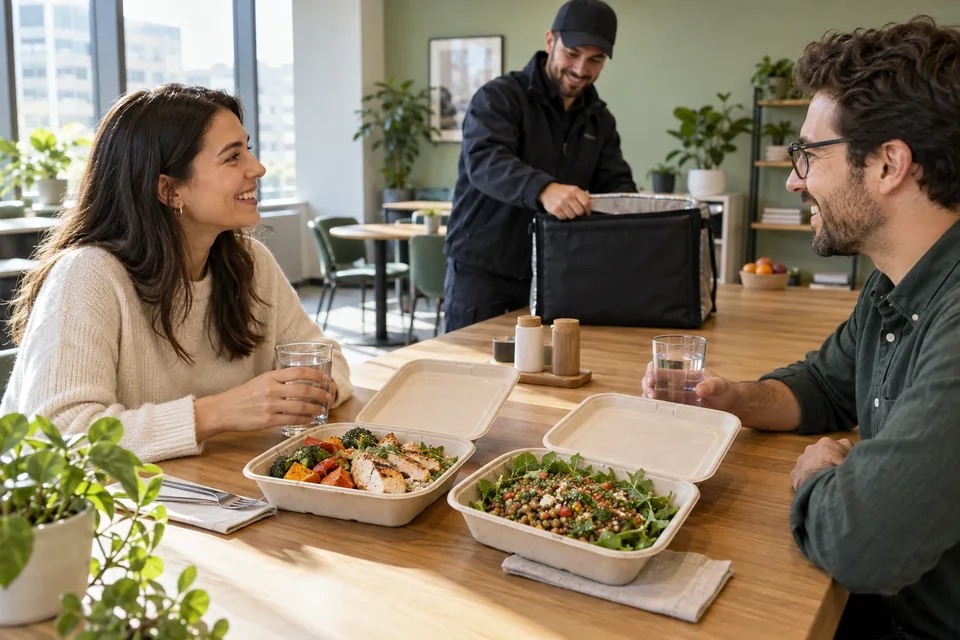
What meal delivery in Tokyo actually covers
Meal delivery in Tokyo means every way of getting a cooked dish to your flat or house in the Japanese capital: a restaurant that sends its own rider, an app that gathers dozens of kitchens, a chain selling boxed meals, a convenience store, or a regular lunch service for older people. The traditional word is demae (出前), historically the soba or sushi brought round by the shop itself, while takuhai (宅配) is the broader term for home delivery of anything.
Tokyo has twenty-three special wards, a sprawling western suburban belt and one continuous built-up area beyond. Homes tend to be compact, working days long and restaurants extremely numerous, so ordering in is entirely ordinary rather than a treat. For a newcomer the real questions are practical: which app to open, how to write an address that a rider can find, and how to cope when the menu is in Japanese only.
Wards and neighbourhoods: where food delivery in Tokyo is busiest
The city is divided into ku (wards), and each ward also runs its own social services. Shinjuku, Shibuya, Minato and Chiyoda are packed with offices, hotels and expatriate housing, so orders there arrive at every hour of the day. Setagaya, Nerima and Suginami are calmer residential and family areas where the evening meal is the peak. Further east, Taito and Sumida keep an old-town feel, and some small restaurants still deliver on foot or by bicycle to neighbours.
Japanese addresses run from district to block to building number rather than by street name. The simplest habit is to copy the address in Japanese from the map inside the app, or ask a Japanese-speaking friend to type it for you. In apartment blocks with entry codes the rider may not come upstairs. Big station districts such as Shinjuku and Ikebukuro offer the widest choice but the least predictable waiting times at rush hour.
Delivery apps and how to order in Tokyo
For meal delivery in Tokyo, Demae-can is a long-established Japanese platform listing pizza, bento, sushi, curry, Chinese dishes and party platters, with plenty of cashless payment options. Uber Eats, Wolt and the Menu app also operate in large parts of the city, and many restaurant chains run their own ordering pages. Coverage depends on your exact address and the time of day, so it pays to type your address into each app and compare.
Payment is usually by card or mobile wallet. Interfaces are in Japanese and sometimes English, but dish names stay in Japanese. When customising an order, three words help: tsuika (extra), nuki (without) and herasu (reduce).
- Enter the full address, including the room number.
- Leave a local phone number if you have one.
- Check whether the order will be left at the door or handed over.
Bento, sushi and tonkatsu: delivered meals that travel well
Japanese cooking suits transport, which is why home-delivered meals here are so reliable. A bento is a compartment box of rice, a protein and side dishes designed to be eaten lukewarm. Rice bowls such as beef gyudon or chicken-and-egg oyakodon, breaded pork tonkatsu and fried chicken karaage all arrive in good shape. Tokyo-style edomae sushi is ordered as ready-to-eat assortments and is best eaten within the hour.
Brothy noodles are a different story: ramen swells and softens, so good shops pack the broth separately. Tempura loses its crispness inside a closed box, and monjayaki, the griddled speciality of Tsukishima, is really a dish for the table in front of you. Raw fish demands a strict cold chain, so eat it straight away and never keep it until the next day.
Doorstep drop-offs, tipping and manners
Meal delivery in Tokyo follows Japanese etiquette: there is no tipping in Japan, and offering money can even cause embarrassment. The rider greets you politely, and a simple arigato gozaimasu is plenty. Contactless delivery, called okihai (置き配), is very common: the bag is left outside your door and the app often sends a confirmation photo.
Apartment buildings have intercoms and parcel boxes. If the rider cannot get in, they will phone or message, and answering quickly avoids a cancelled order. For detached houses, where numbers can be hard to read, mention a visible landmark such as a nearby convenience store.
Alcohol can only be bought from the age of twenty, and ID may be checked on delivery. Japanese packaging normally lists basic ingredients, but if you have an allergy and any doubt remains, ask the restaurant directly.
Meals for older residents: haishoku services and local help
For seniors, delivered meals come as regular meal services known as haishoku (配食サービス), run by specialist companies such as the Watami group, and by some municipalities and associations. Meals arrive in boxes, sometimes adapted to particular dietary needs, and the handover doubles as a brief check that the person is well.
To find out what exists locally, contact the social services office of the ward or the regional support centre for older people (chiiki hokatsu shien center), which knows the providers in its area. Anyone covered by long-term care insurance (kaigo hoken) has a care manager who can help arrange meals.
Eligibility and any cost-sharing depend on the person’s situation and on the ward, so ask the relevant office directly, ideally with an interpreter or a Japanese-speaking relative beside you.
Rainy season, heat and festivals: timing your food delivery in Tokyo
Demae and delivered meals both slow down in bad weather. Tokyo’s rainy season, tsuyu, runs through June and July and is followed by a humid, scorching summer. Rice and fish dishes spoil quickly at room temperature, so put an order in the fridge as soon as it arrives. Autumn typhoons can suspend deliveries altogether, while winter is dry and sunny and brings orders of hot pot dishes such as nabe.
New Year is the great family holiday. Osechi ryori, the assortment of dishes in lacquered boxes, must be reserved several weeks ahead from caterers and department stores. Some restaurants close during Golden Week in early May and for Obon in August, so check opening days before relying on a favourite place.
Choosing a reliable service when you cannot read Japanese
For meal delivery in Tokyo without Japanese, pick an app that offers an English version and shows photographs of each dish. Read recent reviews, confirm that the restaurant really delivers to your ward and note the time the order is promised. If something goes wrong, use the app’s customer service instead of calling the restaurant yourself.
On a stay of a few weeks, round-the-clock convenience stores sell bento, rice balls and hot dishes, and some will deliver. For a group, a caterer can prepare a sushi platter or a spread of dishes for several people; state the number of guests and any dietary restrictions when you book.
Frequently asked questions
How do I order food in Tokyo without speaking Japanese?
Use a platform with an English interface and photos of the dishes, paste the address in Japanese from the app’s map, and leave a phone number the rider can reach.
Do I tip a delivery rider in Tokyo?
No. Tipping is not customary in Japan. A polite thank-you is enough, and leaving the order at your door is very common.
Which apps offer delivered meals in Tokyo?
Demae-can, Uber Eats, Wolt and Menu are the best known. Coverage changes by ward and hour, so compare them using your exact address.
Is there a meals-on-wheels style service for older people in Tokyo?
Yes, regular services called haishoku are offered by companies and municipalities. The ward social services office or the regional support centre for older people can point to providers.