
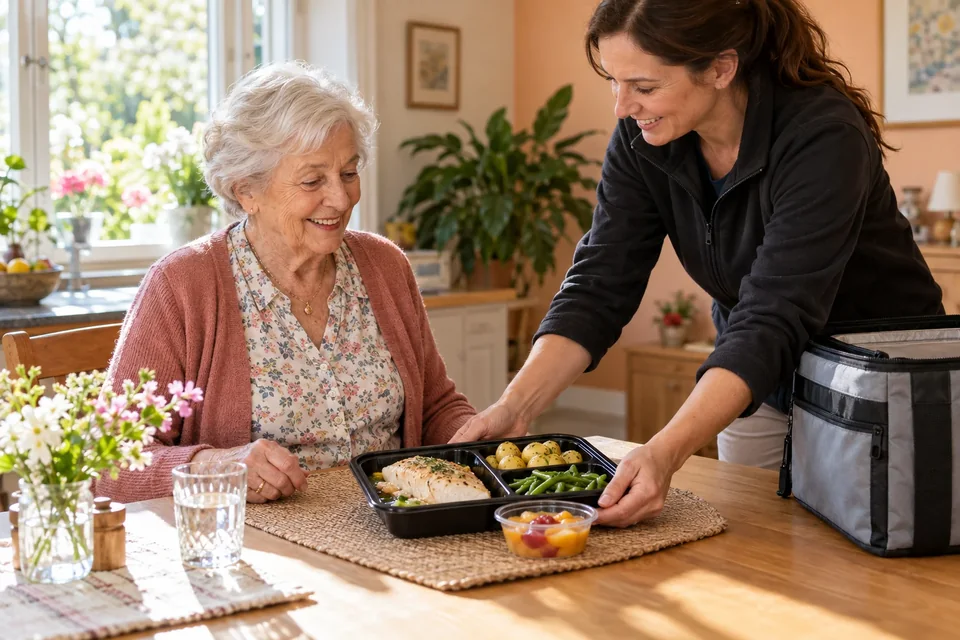
Home meal service Nice: how the municipal scheme works
The home meal service Nice offers is run by the city’s social action centre, the CCAS, and reserved for older people and disabled people who are losing independence and still live at home. It is meals on wheels in the strict sense: a meal prepared from a menu book, handed over regularly at the door, under a contract.
Those who can benefit are retired residents of Nice over sixty who are losing autonomy, and disabled people under sixty holding an invalidity card of at least 80 per cent. The City states that there is no income ceiling and no time limit. The admission request is made on a form, with proof of identity and, depending on the case, documents such as a notice of the personalised autonomy allowance, a recent medical certificate or a tax assessment.
Admission takes effect when the service contract is signed. The contract runs for one year and is renewed automatically.
Chilled meals in practice: how to handle the trays
The principle of chilled meals is simple: dishes are cooked, cooled quickly, sealed in individual trays and carried in a refrigerated vehicle. In Nice the trays are handed over in person, put in the fridge by the person receiving them, then warmed in a microwave or oven.
For a home meal service Nice residents use, as elsewhere, this method has two advantages: it limits the risks of keeping food hot for long, and it allows delivery for several days at once. It does demand a fridge in good order and the ability to reheat a dish. For someone who struggles with trays, a relative or a home carer can do the reheating.
- Check the use-by date on every tray.
- Heat right through and follow the instructions for peeling back the lid.
- Throw away any tray with a bulging pack or an unusual smell.
In summer the heat of the Riviera calls for vigilance: put the meal away as soon as it is handed over and never keep it on a balcony.
Formulas, diets and the meal delivery rhythm
According to the municipal service, a meal is provided for every day of the year. Deliveries take place from Monday to Friday, and weekend meals are handed over beforehand. At least three meals a week must be chosen, and a meal can be cancelled the day before, before noon.
Two formulas exist: the midday meal alone, or the midday meal with an evening snack. On diets, the service offers normal, fish-free, meat-free, pork-free or soft-texture menus. Low-sugar and low-salt diets require a medical certificate, a reminder that the choice of a therapeutic diet belongs to the doctor, never to the person delivering or the provider.
The contribution asked of the beneficiary is calculated from declared income, and the meal is invoiced in arrears on actual consumption. For someone whose home-delivered meals must be adapted, it is better to discuss this when the file is first put together.
Niçoise food to go: socca, pissaladière and stuffed vegetables
The cooking of Nice lends itself well to meal delivery, provided the choice is careful. Here is what stands the journey and what needs attention.
- Socca: this chickpea-flour pancake is best piping hot and loses its crispness fast; reheat it in a very hot oven.
- Pissaladière: an onion, anchovy and olive tart eaten cold or warm, it travels very well.
- Petits farcis: vegetables stuffed with meat, they keep cold and reheat easily.
- Daube niçoise and ravioli: stews and filled pasta cope with transport if the sauce is packed separately.
- Salade niçoise and pan-bagnat: to eat the same day, as the bread absorbs moisture.
- Swiss chard pie: a sweet-and-savoury regional dessert, sturdy and easy to slice.
If you order from a caterer, ask for fresh and cooked elements to be separated, and check for fish, nuts or gluten.
Old Nice, Cimiez and Riquier: delivering on the hills and by the sea
Nice stretches between sea and hills, and food delivery feels it. In the old town, around the Cours Saleya and Place Rossetti, narrow lanes and pedestrian zones oblige the courier to finish on foot among café terraces and tourists. The Promenade des Anglais, the port and the Libération district are easier to reach.
On the heights of Cimiez, Mont-Boron or Saint-Barthélemy, winding roads and villas behind gates call for exact directions: gate number, intercom, and whether a dog lives there. Inland, to the north and west, some districts are poorly served by public transport and rounds are longer.
The tram, the city buses and electric bikes complement each other, but slopes deter couriers on ordinary bicycles. If you live without a lift, say so: the courier then knows to allow time for the steps.
Markets and local produce to pair with delivered meals
The Cours Saleya holds its market of fruit, vegetables and flowers every morning, while the more everyday Libération market brings together traders and growers from the region. Nice olives and Niçoise olive oil, protected by designations of origin, have pride of place there, as do citrus fruit, courgettes and chard from the south-east.
For anyone who can cook a little, a home meal service Nice households combine with market produce works well: a few delivered meals a week, the rest cooked at home. It keeps the pleasure of choice while securing diet on tired days.
The February Carnival and the busiest summer weeks disturb traffic. Order early, above all when a meal has to arrive at a set hour for a birthday or a family visit.
Questions to ask and mistakes to avoid with a meal service
Before opening a file for this scheme or picking another provider, ask the municipal service or any other firm how it handles the unexpected: absence, a hospital stay, a change of address, a missing meal. Ask too about the make-up of menus, how often dishes are renewed and how diets are followed.
The classic mistakes are easy to avoid with home-delivered meals. Many people commit too fast to a number of meals they do not eat, fail to warn of an absence, or leave a tray out of the fridge too long. Others forget to read the allergen notes.
Keep a copy of the contract, note the useful phone numbers and name a trusted person who can be reached. For financial help, ask the service before signing: some contributions depend on declared income and on the documents supplied with the file.
Frequently asked questions
Who can use the municipal meal service in Nice?
Retired residents over sixty who are losing autonomy, and disabled people under sixty with an invalidity card of at least 80 per cent. The City states there is no income ceiling and no time limit.
Are the meals delivered hot?
No. They are delivered chilled in individual trays, put in the fridge and then reheated by the person at home, in a microwave or oven, so a working fridge is needed.
Can a meal be cancelled?
Yes. According to the municipal service, a meal can be cancelled the day before, before noon. At least three meals a week must be chosen.
Which diets are offered?
Normal, fish-free, meat-free, pork-free and soft-texture menus. Low-sugar and low-salt menus need a medical certificate.