
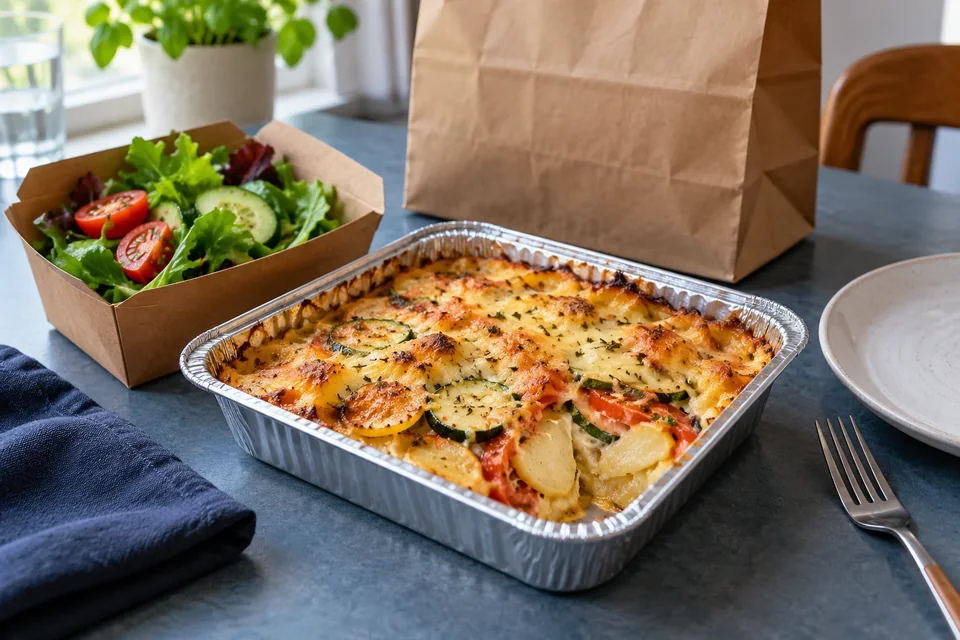
Meal delivery in Trois-Rivières: definition and local realities
Meal delivery in Trois-Rivières means food prepared elsewhere and eaten at home in the city: a restaurant order, takeaway cooking, meals made by a community organisation, or lunches brought by volunteers to people who can no longer cook. The term stretches from a Friday-night supper to the support service that keeps an older resident living independently.
Halfway between Montreal and Quebec City, on the north shore of the St Lawrence at the mouth of the Saint-Maurice river, Trois-Rivières is the main centre of the Mauricie region. Its sectors have distinct identities: the downtown and Old Trois-Rivières, Trois-Rivières-Ouest, Pointe-du-Lac and, along the Saint-Maurice, Cap-de-la-Madeleine, Sainte-Marthe-du-Cap and Saint-Louis-de-France.
Those distances explain why a service that exists in Cap-de-la-Madeleine may not reach Pointe-du-Lac. Before anything else, pin down your exact sector.
Meals on wheels in Trois-Rivières: who cooks and who drives
Meals on wheels in Trois-Rivières, known locally as the popote roulante, rests on volunteer action centres. According to the city’s directory of resources for seniors, the Centre d’action bénévole du Rivage and the Centre d’action bénévole Laviolette each run a popote roulante. Le Rivage, based on rue Fusey, prepares and delivers balanced hot meals and frozen meals.
The same directory lists Ménagez-vous, an organisation that prepares meals without a diet plan, with two territories: Les Forges, covering Trois-Rivières, Trois-Rivières-Ouest and Pointe-du-Lac, and Le Rivage, covering Cap-de-la-Madeleine, Sainte-Marthe-du-Cap and Saint-Louis-de-France.
Such details move on, and a printed leaflet from two years ago can mislead. Hours, territories and criteria change from year to year, so the safest approach is to phone the organisation for your sector and ask what it offers today.
Signing up for a community meal service in Trois-Rivières
The process usually follows four steps. First comes a phone call to the organisation for your sector. Then a short assessment covers age, health, independence and any special diet. Next the organisation confirms delivery days and which meals you want: hot, frozen or both. Finally the service starts, on a date that depends on the organisation.
The CLSC, the local health and social services centre, can smooth the way after a hospital stay or a loss of independence. After surgery a short-term arrangement is sometimes possible, so mention it at the outset.
To prepare, gather the health insurance card, contact details, a list of allergies and a note of foods the person will not eat. Explain how to get into the home or where to leave the meal.
If the person goes into hospital or travels, warn the organisation as early as you can, ideally several days ahead, so a meal is not cooked for nobody. Volunteers also appreciate being told about a new phone number or door code.
Downtown, Cap-de-la-Madeleine, Trois-Rivières-Ouest: ordering from restaurants
For restaurant orders, rue des Forges and Old Trois-Rivières hold a cluster of addresses, while Trois-Rivières-Ouest, around boulevard des Récollets, and Cap-de-la-Madeleine, near boulevard Sainte-Madeleine, have kitchens of their own. Delivery zones often stop at the edge of those sectors.
A useful habit is to phone the restaurant rather than rely on the app alone: staff know which streets they really reach, how long a Friday rush adds, and whether they will cross the Saint-Maurice at all. Ask about the minimum order and whether the delivery fee changes with distance.
Students at the Université du Québec à Trois-Rivières, near boulevard des Forges, are heavy evening users of food delivery in Trois-Rivières. In summer, tourism, the Grand Prix and the festivals thicken traffic and stretch waiting times, so allow some margin.
Before ordering, check that your street is inside the zone. A restaurant can advertise delivery to Trois-Rivières while excluding Pointe-du-Lac or Saint-Louis-de-France.
What Mauricie cooking carries well
For home-delivered meals in Trois-Rivières, traditional Quebec dishes such as meat pies, stews, soups and slow-cooked casseroles travel well. For one person, favour single portions and dishes that keep three to four days in the fridge.
The Mauricie has many farms and sugar shacks: maple syrup, seasonal vegetables, cheeses. Someone who still cooks can combine these purchases with a hot meal delivered daily, keeping the pleasure of cooking without the full chore.
For Christmas-season or birthday meals, order several days ahead. Caterers in the region are in demand at those times and lead times lengthen.
Winter between river and plain: snow, wind and distance
Winter weighs heavily on meal delivery in Trois-Rivières. Between the river and the plain, wind and snow funnel into the downtown streets. Poorly cleared pavements slow couriers on foot. In Pointe-du-Lac or Saint-Louis-de-France, the longer rounds are the first to be suspended in a storm.
Keep frozen meals for two or three days, avoid late orders on stormy nights and make sure the path to the door is clear. If you live alone, tell a neighbour or relative when a delivery is expected.
Food safety: reheating and storing delivered meals
A meal service in Trois-Rivières follows the ordinary rules of food hygiene. A hot meal delivered hot should be eaten within the hour. Leftovers go into the fridge in closed containers. A reheated dish must be piping hot all the way through, stirred halfway. A frozen meal thaws in the fridge rather than on the counter and is not refrozen.
Older people, pregnant women and anyone with weakened immunity should avoid risky foods left for long at room temperature. Where a medical diet applies, the doctor or dietitian sets the rules.
Questions to ask and mistakes to avoid
When choosing meal delivery in Trois-Rivières, always ask about delivery days, the cancellation deadline, what the meals contain and whether a texture can be adapted. Avoid signing up for a long period without a trial, leaving a delivered meal outside, or handing payment to someone who shows no identification.
Note what you like and dislike on the menu: a good organisation listens to feedback.
Other frequent mistakes are assuming a service is free when it asks for a contribution, forgetting to report a holiday or a hospital stay, and waiting until exhaustion to ask for help. A carer who has cooked every meal for a parent for months can start with two deliveries a week, then adjust to the person’s tiredness and appetite.
Think about the human side as well: a volunteer’s regular call is a few minutes’ visit that breaks isolation. If the person stops answering the door, a good service alerts the family or the named contact.
Frequently asked questions
Who runs meals on wheels in Trois-Rivières?
Volunteer action centres, among them the Centre d’action bénévole du Rivage, which prepares and delivers hot and frozen meals. Another centre also covers part of the territory.
Does the service differ between sectors of the city?
Yes. Each organisation covers specific sectors, for example Cap-de-la-Madeleine or Trois-Rivières-Ouest. Ask first which one serves your address.
Can meals be ordered for a short period?
In some cases, notably after a hospital stay. Explain the situation to the organisation.
What if my address is outside the zone?
Contact the CLSC or another organisation, which can direct you to a resource in your sector.