
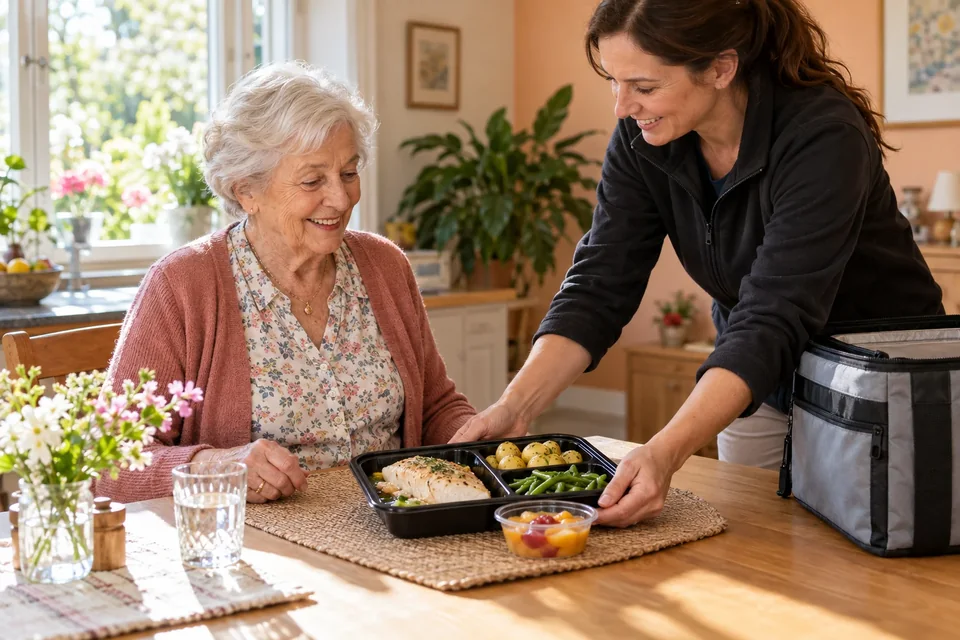
Meals on wheels jobs: a sector built around seniors
Meals on wheels jobs are positions in services that bring complete meals to people who can no longer cook or shop easily, mostly older customers but also people with disabilities or those recovering from illness. Home-delivered meals for seniors come from private companies, charities, local social-action bodies and home-help organisations.
The work differs from ordinary food delivery in its human side. The driver often calls every week, sometimes every day, on the same people. He or she becomes a familiar face, occasionally the only one the customer sees all day. Because of this social responsibility, recruiters look at manner as much as at the driving licence.
Anyone considering meals on wheels jobs should picture the routine honestly: early starts, many short conversations, stairs, weather and the satisfaction of knowing that a regular meal really arrived. Some people discover that this steady, close-up contact suits them far better than the pressure of app-based courier work.
Charities often rely on volunteers for part of the work, while paid posts exist alongside them in larger organisations. If you are unsure, a short trial or a volunteer shift is a sensible way to find out whether the job fits.
Who works in a meal service: driver, packer, coordinator
Several trades share one chain. The driver handles the round, from loading the vehicle to handing over each meal. The order picker assembles trays and parcels according to each customer’s diet. In the kitchen, cooks and kitchen assistants prepare menus suited to older people’s needs.
- Driver: drives, delivers, checks temperatures and chats with customers.
- Order picker or storekeeper: prepares orders and manages cold storage.
- Round manager: plans routes, covers absences and handles complaints.
- Dietitian or quality manager: validates menus and follows hygiene checks.
- Customer-service officer: records sign-ups, menu changes and absences.
Qualities expected of a meals on wheels driver
For a meals on wheels driver, punctuality comes first: an older person waiting for lunch at a fixed time soon worries about a delay. Organising the round, knowing the neighbourhoods and driving safely are essential.
Relational qualities follow: patience, listening, a calm voice and respect for the person and the home. Some customers are hard of hearing, others live with memory problems. The driver learns to repeat without irritation, to notice a shutter that stays closed or post piling up, and to tell a supervisor.
Safe hygiene habits are also vital: clean hands, suitable clothing, a well-kept vehicle or insulated crate and respect for storage temperatures. Employers often add in-house training on arrival.
Health basics matter as well. A good meals on wheels driver recognises when a customer seems confused, unwell or unusually quiet, and knows that the proper response is to pass the observation on rather than to diagnose or advise.
How to apply: background, courses and first steps
No particular diploma opens the door to a driver post, but several backgrounds help. Training in catering, logistics or personal services gives a solid base. People from home care, activity leadership or institutional catering find a natural route in.
To apply, look at vacancies from services in your area, from councils and their social-action offices and from companies delivering meals. A speculative application with a short CV stating your licence and availability is often well received.
Public training centres and retraining bodies run courses in transport, logistics and personal services. A job centre adviser can guide you, fund certain modules and put you in touch with employers.
Contracts, hours and the shape of a round
Contracts range from fixed-term to permanent, full or part time. Hours cluster in the morning and early afternoon, because lunch must arrive before the usual mealtime. Some services drop off several meals at once for the whole week, which changes the rhythm of the round.
A typical round runs like this: load meals prepared the day before or that morning, check the customer list, follow a route planned by address, return to the depot and clean the equipment. In rural areas distances are longer and driving takes a bigger share of the day; in towns, parking and staircases slow things down.
Conditions vary by employer and by agreement. Ask for the pay scale, travel expenses and cover arrangements before committing.
Holiday periods deserve a question of their own. Customers still need to eat on bank holidays and during the winter break, so many services run reduced rounds or batch deliveries, and the way these extra duties are shared out says a lot about an employer.
Hygiene and safety on the job
In a home-delivered meals service, food safety rests on the cold chain and on the driver’s discipline. Meals stay cool until handover, in insulated crates or refrigerated vans. On receipt, the customer gets clear storage and reheating instructions.
- Wash hands before the round and between homes if needed.
- Never leave meals in a vehicle heated by the sun.
- Respect the use-by dates printed on the trays.
- Report damaged packaging or labelling faults at once.
Road safety matters too: calm driving, safe stops and no phone at the wheel. On some rounds the employer also trains staff in first-aid basics.
The social side of the job
Beyond handing over a tray, the driver often keeps watch. He or she may notice a customer walking with more difficulty, yesterday’s meal left untouched or a door slow to open. The role is not medical: the information goes to the manager, who contacts the family or the relevant service.
This closeness demands discretion. What is learned inside a home stays confidential. The driver asks for no money beyond what the contract provides and declines significant gifts. These rules protect customers and employees alike.
For many professionals, that dimension gives the work its meaning. It also calls for the ability to keep some distance, to be relieved when tired and to talk with colleagues.
Where a career in home-delivered meals can lead
An ageing population and the wish to stay at home sustain demand for services delivered to the door. Careers can therefore progress from driver to round manager, then to area coordinator or branch manager. Kitchen staff can move towards running a production unit.
A driver may also turn to home care or support for older people, with extra training. Others set up their own delivery activity while remaining a partner of an existing provider.
Needs differ from region to region, and organisations recruit according to their markets and funding. Enquire locally: the home-support services of your area and social-action offices know who is hiring.
Frequently asked questions
Do meals on wheels jobs require a degree?
No specific diploma is needed for driver roles. Catering, logistics or care backgrounds help, and employers often train on arrival.
When do rounds usually take place?
Mostly in the morning and early afternoon, so that lunches arrive before the usual mealtime.
Is a meals on wheels driver a carer?
No. The role is not medical. Drivers pass concerns to a manager, who contacts the family or the appropriate service.
What if nobody answers the door?
The driver follows the employer’s procedure: try again, phone, then inform the manager.